
Description
PPR Pipe 25mm
DADEX PPRc pipes and fittings local ,, Food Grade, Plumbing Materials, Distributor Suppliers in Islamabad Pakistan Contact 0322-3540656
What is PPR Pipe 25mm DADEX ?
I’ll break it down into sections for clarity: description, specifications, installation guidelines, and usage. This information is based on standard industry data for DADex products, which are manufactured by Dadex Polytech Limited (a leading Pakistani plastics company). DADex’s Polydex and Thermoline lines are popular PPR (Polypropylene Random Copolymer) piping systems known for their durability and compliance with international standards like DIN 8077/8078 and ISO 15874.
Description
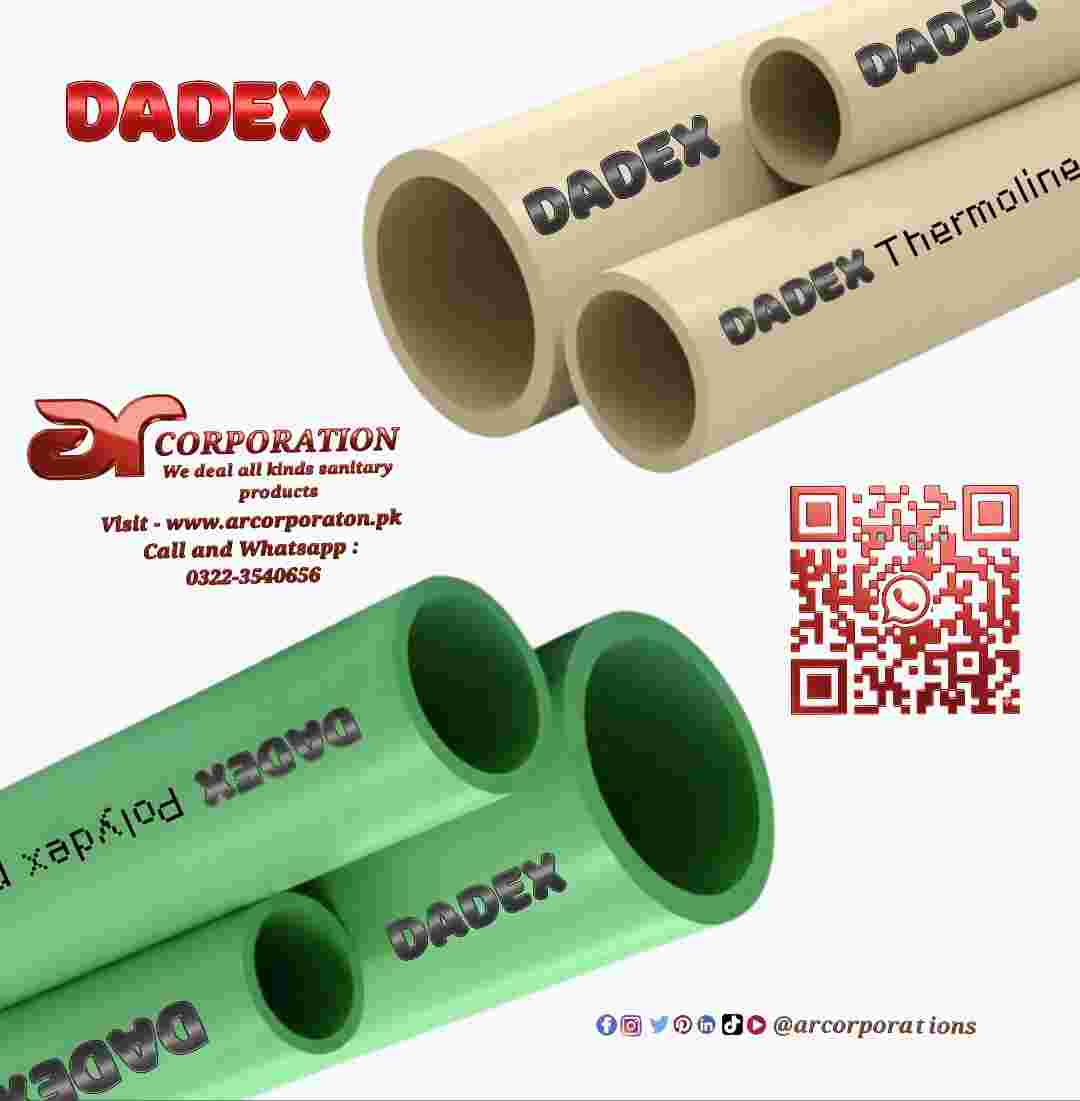
DADex PPR Pipe 25mm (PN 20) from the Polydex or Thermoline series is a high-performance, thermoplastic piping system made from Polypropylene Random Copolymer (PPR).
- Polydex Series: This is DADex’s general-purpose PPR line, emphasizing corrosion resistance, thermal stability, and long-term reliability. It offers enhanced heat resistance and insulation properties, making it ideal for HVAC systems where temperature fluctuations are common.
These pipes are non-toxic, hygienic, and eco-friendly, as they do not leach harmful substances into the water supply. The “25mm” refers to the outer diameter (OD), and “PN 20” indicates a pressure rating of 20 bar (290 psi) at 20°C, suitable for high-pressure hot water systems up to 95°C.
Specifications
Here are the key technical specifications for DADex PPR Pipe 25mm PN 20 (Polydex/Thermoline). These are based on standard DADex product data; lengths are typically supplied in 4m or 5m coils/sticks.
- Material: Polypropylene Random Copolymer (Type 3, PPR-H or PPR-B), food-grade and certified for potable water (WRAS/NSF approved equivalents).
- Dimensions:
- Outer Diameter (OD): 25 mm
- Wall Thickness: 4.3 mm (minimum, for PN 20 rating)
- Inner Diameter (ID): Approximately 16.4 mm
- Standard Length: 4 meters (straight lengths) or coiled for easier handling
- Weight: Approximately 0.45–0.50 kg per meter (lightweight for easy transport and installation).
- Standards Compliance:
- DIN 8077/8078 (Germany) for PPR pipes and fittings.
- ISO 15874 (International) for plastic piping systems for hot and cold water.
- ASTM F2386 (USA) equivalents for pressure-rated PPR.
- Local: Pakistan Standards (PS) for plumbing pipes.
- Physical Properties:
- Density: 0.90–0.91 g/cm³
- Tensile Strength: >25 MPa
- Elongation at Break: >50%
- Thermal Conductivity: 0.24 W/m·K (low, providing natural insulation)
- Linear Expansion Coefficient: 0.00015 /°C (requires expansion loops in long runs)
- Color: Typically green (for cold water) or gray/blue (for hot water/HVAC), with possible custom options.
- Fittings Compatibility: Fusion-welded (socket fusion or butt fusion) with matching DADex PPR fittings (elbows, tees, valves, etc.). Threaded adapters available for connection to metal pipes.
- Lifespan: 50+ years under normal conditions (based on 10,000-hour hydrostatic tests at elevated temperatures).
- Certifications: Halal-certified materials, lead-free, and recyclable. Tested for hydraulic shock resistance and burst pressure (up to 4x rated pressure).
For HVAC-specific variants (Thermoline), additional insulation layers may be available to minimize heat loss.
Installation
Installation of DADex PPR Pipe 25mm PN 20 is straightforward, socket-fusion based, and requires minimal tools. Always wear PPE (gloves, eye protection) and work in well-ventilated areas. Professional installation is recommended for HVAC systems to ensure pressure integrity.
- PPR pipe cutter or hacksaw (for clean, square cuts).
- Socket fusion welding machine (heated tool at 260–280°C for 5–10 seconds per joint).
- Cleaning agent (isopropyl alcohol) and chamfering tool.
- Measuring tape, markers, and support brackets (every 1–1.5m horizontally, 1m vertically).
- Expansion compensators for runs >10m.
- Planning and Preparation:
- Measure and mark pipe lengths accurately.
- Ensure the system pressure does not exceed PN 20 limits based on operating temperature.
- For HVAC/hot water: Insulate pipes with foam sleeves to prevent condensation and heat loss.
- Clean pipes and fittings thoroughly to remove dust or grease.
- Cutting and Preparation:
- Cut the pipe square using a cutter. Chamfer the outer edge (1–2mm) to prevent burrs from entering the joint.
- Mark the insertion depth on the pipe (usually equal to the socket depth of the fitting, ~20–25mm for 25mm pipe).
- Fusion Welding (Primary Method):
- Avoid over-heating to prevent material degradation.
- For butt fusion (larger joints): Align ends, heat, and press together under controlled pressure.
- Connections and Supports:
- Use threaded adapters for connecting to existing metal/GI pipes (apply PTFE tape on threads).
- Secure pipes with plastic clamps or metal hangers (avoid metal-to-PPR direct contact to prevent abrasion).
- Pressure Testing:
- Check for leaks using soapy water.
- For hot water/HVAC: Perform thermal cycling tests (alternate hot/cold) to verify expansion joints.
- Common Precautions:
- Minimum bend radius: 5x OD (125mm for 25mm pipe) to avoid kinking.
- Time to full pressure: Wait 24 hours post-installation before full use.
- Cost Estimate: In Pakistan (as of 2023 data), a 4m length of 25mm PN 20 pipe costs PKR 800–1,200; installation labor ~PKR 500–1,000 per joint.
Usage
DADex PPR Pipe 25mm PN 20 (Polydex/Thermoline) is versatile for fluid transport in controlled environments. It’s not suitable for gas, compressed air, or outdoor UV-exposed applications without protection.
- For Hot and Cold Water Supply:
- Ideal for domestic/commercial plumbing: Potable drinking water distribution, under-sink lines, and booster pump systems.
- Example: In a home in Rawalpindi, use for connecting to municipal supply or solar water heaters.
- For HVAC Applications:
- Used in radiant floor heating, underfloor cooling, fan coil units, and chiller piping.
- Thermoline variant excels in hydronic systems (hot water circulation for heating/AC).
- Pressure/Temp Suitability: Safe for loops up to 80–95°C with glycol mixtures (anti-freeze).
- Benefits: Corrosion-free in humid HVAC environments, quiet operation (no water hammer), and easy integration with PPR manifolds.
- Example: In commercial buildings, for distributing chilled/hot water from AHUs (Air Handling Units) to diffusers.
- General Advantages:
- Maintenance: Minimal; inspect joints annually for leaks.
- Limitations: Not for pressures >20 bar or temps >95°C (use higher PN ratings like PN 25 for that). Avoid dragging on rough surfaces to prevent scratches.
- Maintenance Tips:
- Flush annually to remove sediment.
- Monitor for pressure drops indicating leaks.

Reviews
There are no reviews yet.