
Description
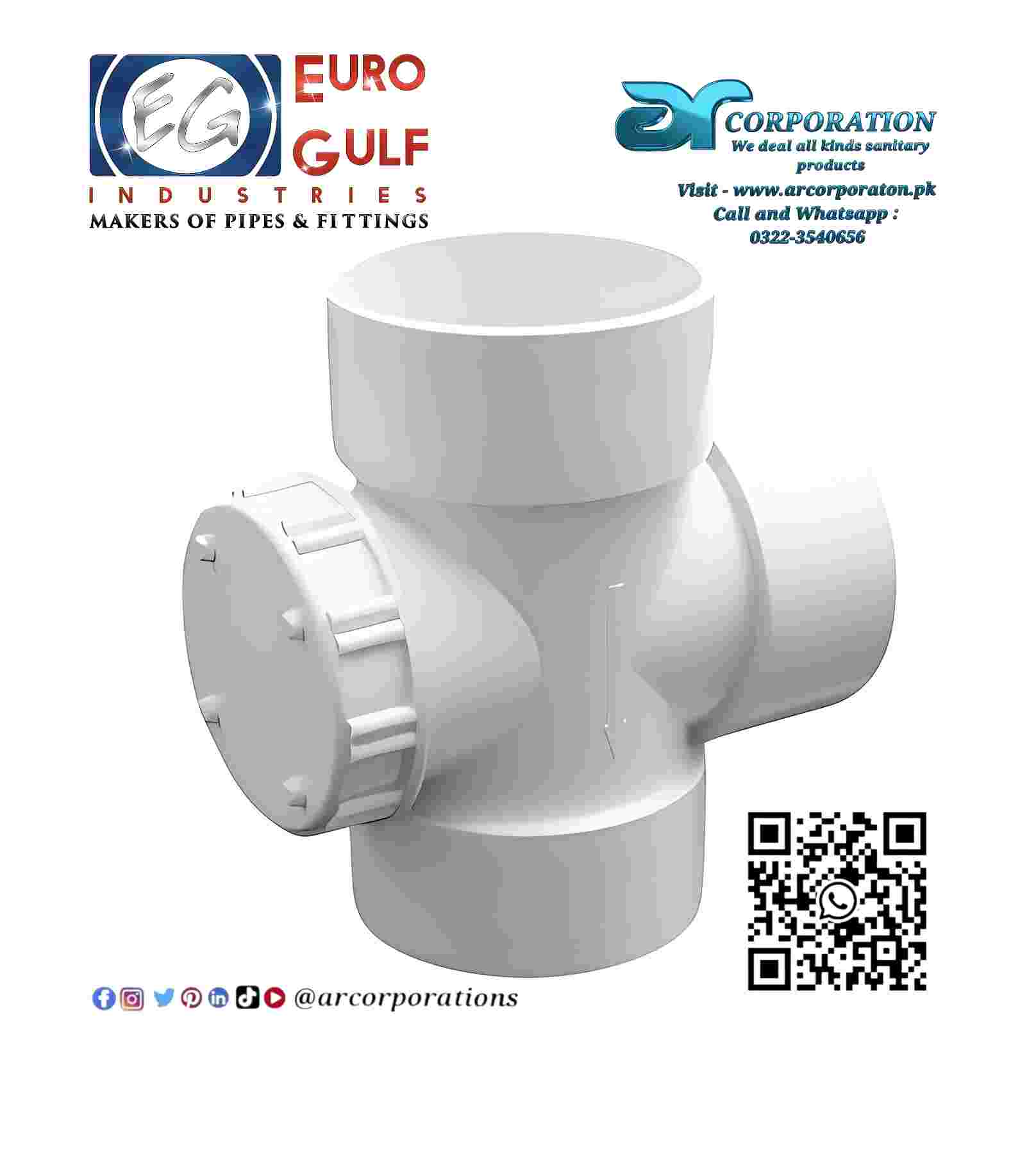
upvc Plug Tee 4″
Euro Gulf local Suppliers Dealer in Karachi Pakistan Contact 0321-2248975 ASTM uPvc Sch-40 Pressure Fittings, Drain sewer ventilation
What is Euro Gulf upvc Plug Tee 4″ ?
A uPVC Plug Tee is a three-way pipe fitting shaped like the letter “T,” made from un plasticized polyvinyl chloride (uPVC). It has:
-
Two straight connections (run) for 4″ UPVC pipe
-
One branch outlet that comes with a removable plug/cap on it
The plug allows access into the pipeline for inspection, testing, cleaning, or future connections without dismantling the entire pipe system.
Euro Gulf is a brand/manufacturer of PVC products where the Plug Tee follows general uPVC fitting practices and ASTM standards (e.g., ASTM D2466 for Schedule 40 fittings).
🧱 Material and Construction
-
Material: uPVC (Un plasticized Polyvinyl Chloride) – rigid and corrosion-resistant.
-
Standard: Typically manufactured to ASTM D2466 (Schedule 40 pressure fittings) or similar regional standards.
-
Color: White (common for uPVC plumbing/pressure applications).
-
Connection Type: Slip (socket) ends that accept solvent cement welded pipe and a threaded plug on the branch (if fitted) for closure.
-
Temperature Rating: Up to ~60 °C (140 °F).
-
Pressure Capability: Rated for cold/ambient temperature water systems and moderate pressure typical of Schedule 40 pipes/fittings (pressure rating decreases as temperature rises).
Note: uPVC fittings hold higher strength at ambient/cold water temperatures; hot water (above ~60 °C) reduces mechanical strength and pressure rating unless specifically rated.
🧪 Specifications Euro Gulf upvc Plug Tee 4″
| Property | Details |
|---|---|
| Nominal Size | 4″ |
| Standard | ASTM D2466 / Comparable |
| Material | uPVC (PVC-U) |
| Connection | Solvent weld sockets / threaded plug |
| Max Operating Temp | ~60 °C (140 °F) |
| Dielectric | High (non-conductive) |
| Corrosion Resistance | Excellent (resists many chemicals) |
| UV Resistance | Fair (additives may vary by brand) |
| Weight | Lightweight (depends on exact design) |
💡 How It’s Installed
The installation of uPVC plug tees follows general solvent-weld joining and fitting best practices.
🔧 Tools & Materials
-
Pipe cutter or fine saw
-
Deburring tool
-
Clean cloth
-
uPVC primer and solvent cement
-
PTFE tape or thread sealant (optional)
-
Wrench (for plug fitting)
🛠 Steps
-
Measure & Cut:
Cut the UPVC pipe squarely. Deburr the cut edge to remove sharp edges. -
Dry Fit:
Insert pipes into the plug tee sockets to check alignment. Ensure correct depth before applying cement. -
Apply Primer (If Required):
Apply primer to pipe end and fitting socket surfaces. (Local code may or may not require primer.) -
Solvent Cement:
Apply solvent cement evenly on the pipe end and fitting socket. -
Assembly:
Quickly insert the pipe into the fitting, twist slightly, and hold for ~30 sec until joint sets. -
Install Plug:
Screw the plug into the branch outlet. Use PTFE tape or sealant on threads for a leak-free seal, but do not over-tighten to avoid cracking. -
Cure Time:
Allow recommended cure time (often 24 hours) before pressure testing or operation.
🚰 Usage & Applications
🔹 HVAC Systems
-
Drain and condensate lines — branches from main drain pipes for air-conditioning units.
-
Service access points — the removable plug offers a cleanout.
🔹 Hot & Cold Water Supply
-
Cold water piping: Suitable up to rated temperature (~60 °C) in potable/non-potable systems.
-
Branching: Allows splitting mains to secondary runs.
-
Future expansion/access: The plug enables installation of valves or extensions later.
⚠️ Caution: Not ideal for continuous hot water supply above 60 °C unless manufacturer specifically rates it as CPVC or high-temp PVC. uPVC generally softens above ~60 °C.
🔹 Plumbing & Sanitary
-
House plumbing, branching to bathrooms/kitchens.
-
Inspection/cleanout provision in drain systems.
🔹 Industrial & Irrigation
-
Branch tees in low-pressure fluid transport systems.
-
Chemical handling where compatible (check chemical resistance).
⚙️ Advantages of UPVC Plug Tee
✅ Corrosion-resistant: Does not rust with water or many chemicals.
✅ Lightweight & easy to install: Doesn’t require welding machines.
✅ Low cost: More affordable than metal fittings.
✅ Smooth internal bore: Reduces friction and build-up.
📌 Limitations
-
Temperature constraint: Not suitable for sustained hot water over ~60 °C unless upgraded to CPVC/heat-rated material.
-
UV exposure: Long-term sunlight can degrade uPVC unless UV-stabilized.
-
Pressure: Schedule 40 pressure rating decreases with rising temperature.

Reviews
There are no reviews yet.