
Description
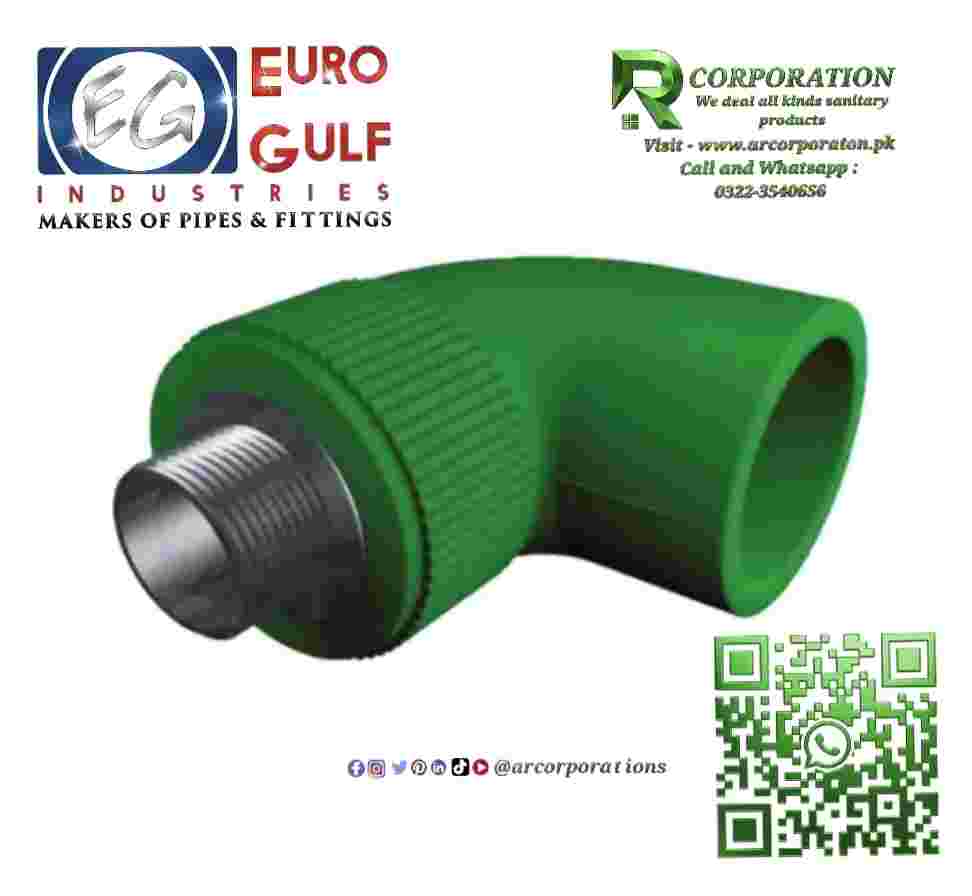
Elbow male 25×3/4″ Brass
EG PPRc pipes and fittings local ,, Food Grade, Plumbing Materials, Dealer Suppliers in Karachi Pakistan Contact 0321-2248975,
What is Elbow male 25×3/4″ Brass EG PPRc ?
Product Overview
The “Elbow Male 25×3/4″ Brass EG PPRc 25″ is a brass transition elbow fitting designed for 90-degree directional changes in polypropylene random copolymer (PPRc) piping systems. It’s part of the EG (or similar) brand series, commonly used in plumbing for connecting PPRc pipes to threaded components. The fitting features a male threaded end (3/4” NPT or BSP) and a 25mm PPRc socket, rated for PN 25 (nominal pressure of 25 bar at 20°C). It’s ideal for HVAC systems, hot and cold water supply lines, and other applications requiring corrosion-resistant, durable connections. This elbow ensures smooth flow redirection while bridging plastic PPR pipes to metal or threaded systems, complying with standards like DIN 8077/8078.
Description
- Material: High-grade brass (e.g., CW617N dezincification-resistant alloy) for excellent corrosion resistance, durability, and compatibility with water and heating fluids.
- Design: A 90-degree elbow with one male threaded port (3/4″ external thread) and one PPRc socket end (25mm diameter). The threaded end connects to female-threaded components like valves or pipes, while the PPRc end fuses to PPR piping. It’s compact and lightweight, with a smooth internal bore to minimize turbulence and pressure loss.
- Key Features:
- Leak-proof and reliable under pressure due to precise threading and fusion welding.
- Suitable for hot and cold water applications (up to 95°C for hot water).
- Often color-coded (e.g., blue for cold, red for hot) for easy system identification.
- Resistant to scaling, chemicals, and thermal cycling.
- Common Applications: HVAC systems (e.g., radiator connections, boiler loops), potable water supply, underfloor heating, and industrial piping where directional changes are needed in mixed-material setups.
Specifications
- Dimensions:
- PPRc Socket Diameter: 25mm (outer diameter of pipe it connects to).
- Threaded End: 3/4″ male (external thread; compatible with 3/4″ female NPT or BSP threads).
- Bend Angle: 90 degrees.
- Overall Dimensions: Typically 60-80mm in length and height (varies by manufacturer).
- Wall Thickness: Designed for PN 25 strength.
- Pressure and Temperature Ratings:
- Nominal Pressure (PN): 25 bar (at 20°C).
- Maximum Working Pressure: Up to 25 bar for cold water; derates to ~10-15 bar at 95°C for hot water (per DIN standards).
- Temperature Range: -20°C to +95°C (continuous use).
- Standards Compliance:
- EN ISO 15874 (for PPR piping systems).
- DIN 8077/8078 (for PPR pipes and fittings).
- ASTM F2389 (for PPR fittings in North America, if applicable).
- Thread Standards: NPT (National Pipe Thread) or BSP (British Standard Pipe), depending on region.
- Other Specs:
- Burst Pressure: >50 bar (with safety margin).
- Flow Characteristics: Low pressure drop due to smooth elbow design.
- Weight: Approximately 100-150g.
- Certifications: Often CE marked, WRAS approved for potable water use.
Installation
Installation involves PPR fusion welding and threading, requiring a PPR welding tool and basic plumbing equipment. Depressurize the system and use safety gear (gloves, goggles).
-
Preparation:
- Cut the PPRc pipe squarely using a pipe cutter.
- Deburr and clean the pipe end with a cleaner to ensure a contaminant-free surface.
- Verify that the fitting and pipe are dry.
-
Fusion Welding (PPRc End):
- Use a PPR welding machine with a 25mm socket die.
- Heat the fitting’s PPRc socket and pipe end to 260-280°C for 5-10 seconds.
- Insert the pipe into the socket straight (no twisting), and hold for 10-15 seconds to allow cooling and bonding. Avoid overheating.
-
Threaded Connection (Male End):
- Apply thread sealant (e.g., Teflon tape or pipe dope) to the male thread.
- Screw the male thread into the female component (e.g., valve or pipe) by hand, then tighten with a wrench (1-2 turns) for a secure seal. Do not overtighten.
-
Testing:
- Gradually pressurize the system and inspect for leaks with soapy water or a pressure tester.
- Allow fusion joints to fully cure (24 hours) before operation.
-
Tips:
- Install in a ventilated space; PPR welding produces minimal fumes.
- Use pipe supports for concealed or load-bearing installations to prevent joint stress.
- Follow local codes (e.g., UPC or IPC) for proper installation.
Usage
- Primary Use: As a directional change fitting in PPRc systems for HVAC (e.g., routing pipes around corners in heating loops) and water supply (e.g., connecting to faucets or pumps at 90-degree angles). It facilitates transitions from plastic PPR to threaded metal components in residential, commercial, or industrial settings.
- Advantages: Faster installation than all-metal elbows, superior corrosion resistance, and good thermal expansion handling. Reduces noise and vibration in water lines.
- Maintenance: Minimal; inspect for leaks periodically. No special upkeep required if properly installed.
- Limitations: Not suitable for highly corrosive fluids or temperatures above 95°C. Avoid direct soil contact without protection.
- Safety Notes: Match PN 25 rating to system demands to avoid failure. Ensure WRAS approval for drinking water systems.

Reviews
There are no reviews yet.