

Description
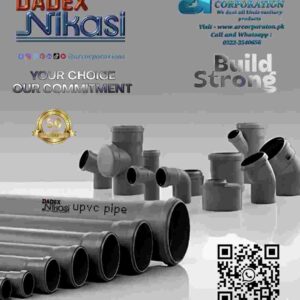
upvc Elbow 160mm
Dadex Nikasi local Manufacturer Suppliers in Islamabad Pakistan Contact 0322-3540656 Pressure Fittings, Drain sewer ventilation
What is Dadex Nikasi upvc Elbow160mm ?
Dadex Nikasi uPVC 160 mm elbows are fittings used to change direction in soil, waste, drain, sewer and ventilation (SWV) lines, available in both solvent‑weld and rubber ring push‑fit (pressure‑type) jointing styles.
Product description
-
Brand/system: Dadex Nikasi, uPVC SWV (soil, waste, vent) drainage system.
-
Material: Un plasticized PVC (uPVC), non‑corrosive and chemically resistant to typical domestic and many industrial waste effluents.
-
Function: Elbow fitting to change pipeline direction (commonly 87.5°, 45° etc.) in 160 mm main stacks or horizontal drains.
-
Joint types available:
-
Solvent socket (solvent cement welded).
-
Rubber ring push‑fit (elastomeric sealing ring) for pressure‑type or low‑pressure drainage applications.
-
Sizes, standards and range
-
Nominal size: 160 mm outside diameter, typically used for main soil/waste stacks and larger underground or building drains.
-
System range: Pipes and fittings in 40, 50, 75, 110, 160 and 200 mm, standard pipe lengths 3 and 4 m; elbows and other fittings match these sizes.
-
Standards (Nikasi range):
-
Pipes: ISO 3633:2002(E) / EN 1329:1999 and PS 3214 (Pakistan standard for PVC plumbing).
-
Fittings (solvent and rubber‑ring): ISO 3633 (SWV fittings standard).
-
Rubber rings: PS 1915 and ISO 4633 for elastomeric seals.
-
Key properties and performance
-
Hydraulics: Smooth bore and accurately formed bends give low flow loss; good self‑cleansing velocity in SWV systems.
-
Corrosion/chemical resistance: Non‑corrosive, resistant to many household and sanitary effluents and commonly encountered sewer gases.
-
Physical characteristics: Light weight, easy to handle and install, good impact strength for building drainage use.
-
Fire/electrical: Self‑extinguishing (does not sustain flame) and non‑conductive to electricity.
-
Biological: Resistant to organic growth inside the pipe (algae, fungus) under normal drainage conditions.
Solvent‑weld elbow – jointing and use
Typical usage
-
Internal soil and waste stacks from WCs, basins, showers, floor drains.
-
Changes of direction at floor levels, offsets, and connection of branch lines where rigid, permanent joints are acceptable.
Jointing steps (general from Nikasi solvent system)
-
Cut pipe square and chamfer the spigot end; clean and dry pipe and socket.
-
Apply Dadex uPVC solvent cement uniformly on pipe spigot and inside fitting socket (thin, even film).
-
Immediately push pipe fully home into elbow socket with a slight twist, hold a few seconds to set.
-
Wipe off excess cement; allow recommended curing time (commonly about 24 h) before pressure or leak testing.
Advantages
-
Rigid, monolithic joints with very low risk of movement.
-
Excellent leak tightness for gravity SWV and low‑pressure applications when correctly installed.
Rubber ring push‑fit (pressure‑type) elbow – jointing and use
Typical usage
-
Drain, sewer and vent lines where:
-
Some ground or structural movement is expected.
-
Disassembly or replacement may be needed.
-
-
Suitable for underground drainage, building connection sewers and vent risers.
Jointing steps (general from Nikasi push‑fit system)
-
Clean pipe spigot and socket groove; make sure surfaces are smooth and dry.
-
Insert correctly sized rubber ring in socket groove of elbow.
-
Lubricate spigot and rubber ring with approved lubricant.
-
Align and push pipe spigot into socket up to the insertion depth mark, without twisting the rubber out of position.
Advantages
-
Quick installation, no curing time; line can be commissioned soon after assembly.
-
Accommodates minor angular deflection and thermal/ground movement, maintaining seal via the elastomeric ring.
Typical applications in SWV design
-
Soil stacks from WCs and bathrooms (87.5° or 45° elbows at offsets and foot of stack).
-
Waste connections from kitchen and washroom fixtures to main stack or branch drain.
-
Underground drain and sewer lines from building to external manholes using 160 mm diameter mains.
-
Ventilation stacks and vent offsets above roof level (used with vent cowls, P‑traps and other Nikasi fittings).


Reviews
There are no reviews yet.