
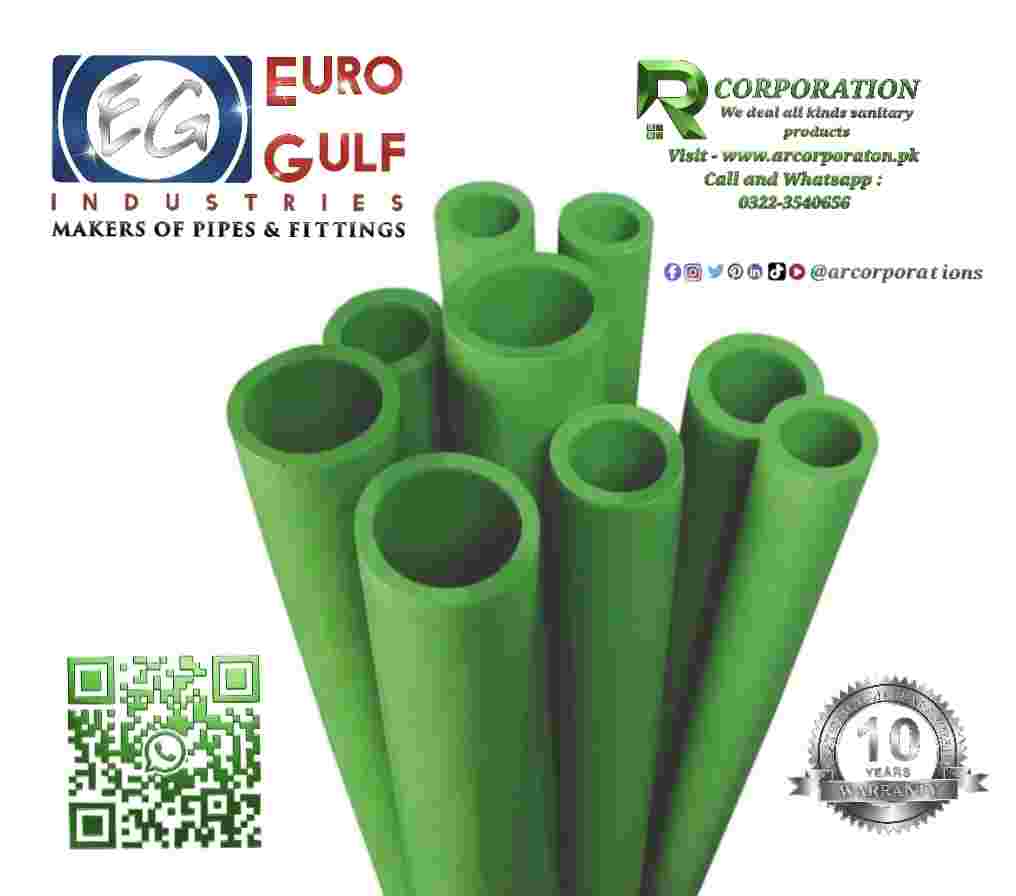
Description
PPR Pipe 50mm
EG , PPRc, Food graded third generation Poly propylene materials. Sizes ranging from 25mm to 110mm diameter. Karachi contact 0321-2248975
What is PPR Pipe 50mm EG euro gulf ?
PPR (Polypropylene Random Copolymer) pipe is a type of plastic pressure pipe widely used in plumbing and HVAC systems for hot and cold water supply. It’s made from a thermoplastic material — PP-R — that has excellent mechanical and thermal properties.
Key characteristics:
-
Material: Polypropylene Random Copolymer (PPR) — stable, tough, hygienic.
-
Pressure Rating: PN 20, meaning the pipe is rated for up to 20 bar nominal pressure at standard test conditions (~20 °C).
-
Temperature Handling: Typically up to ~95 °C short-term and ~70–80 °C continuous service.
-
Standards: Usually manufactured to DIN 8077 / DIN 8078 & ISO 15874 standards.
-
Colour: Often green, but depending on brand may vary (white/black with UV protection).
EG / Euro Gulf Brand: “EG” or Euro Gulf likely denotes a brand/manufacturer name. The pipe still follows common industry specifications for PN20 PPR pipes.
📊 Specifications PPR Pipe 50mm EG euro gulf
While exact figures depend slightly on brand, typical PN20 50 mm PPR pipe specs include:
| Parameter | Value / Description |
|---|---|
| Nominal Diameter | 50 mm outer diameter |
| Wall Thickness (SDR6 / PN20) | ~8.3 mm (varies by manufacturer) |
| Pressure Class | PN 20 (up to 20 bar) |
| Operating Temp. | -20 °C to ~70 °C continuous, ~95 °C short term |
| Material | PPR (Polypropylene Random Copolymer) |
| Standard | DIN 8077 / 8078 & ISO 15874 |
| Application | Hot & cold water, HVAC, pressurised water networks |
SDR (Standard Dimension Ratio): For PN20, pipes are usually SDR6 — meaning relatively thick walls for high pressure.
📍 Why Choose PN20 PPR Pipe?
Advantages:
✅ High Pressure Capacity: Suitable for systems with pressures up to ~20 bar.
✅ Temperature Stability: Handles hot water & HVAC use well.
✅ Long Lifespan: Over 50 years in normal service.
✅ Hygienic: Doesn’t affect water taste; safe for potable water.
✅ Corrosion & Scale Resistant: Won’t rust or scale like metal pipes.
✅ Smooth Inner Wall: Reduces friction & pressure loss.
✅ Lightweight & Easy Handling: Easier and faster installation than metal.
🏗️ Common Uses
Hot & Cold Water Supply
Used in residential, commercial, and industrial plumbing systems for:
-
Kitchen and bathroom water lines
-
Building potable water mains
-
Hot water distribution (up to design heat limits)
HVAC Systems
-
Chilled water lines
-
Hot water recirculation
-
Air-conditioning & heating circuits (depending on system design)
Other Applications
-
Industrial water systems
-
Solar water heating lines
-
Floor heating systems
-
Compressed air and some chemical systems (with correct design)
🛠️ Installation & Connection
🔧 Tools & Materials
-
PPR welding machine (socket fusion) — for heat fusion joining.
-
Cutters & deburring tool — for clean pipe ends.
-
Clamps & hangers — support pipe runs.
🔌 Joining Method
PPR pipes are joined by heat fusion welding, where pipe and fitting are heated and welded into one continuous unit. This creates a homogenous, leak-proof connection.
Steps (General):
-
Measure & Cut: Cut pipe squarely with a specialized cutter.
-
Clean Ends: Ensure pipe ends are free of dirt.
-
Pre-Heat: Heat both pipe and fitting ends with a fusion tool.
-
Insert & Weld: Press together for the specified fusion time.
-
Hold & Cool: Hold until cooled to form a solid joint.
📏 Support & Spacing
-
Support pipe with clips/hangers every ~800–1200 mm horizontally.
-
For vertical lines, spacing may be closer.
-
Allow for thermal expansion — PPR expands with heat.
💧 Testing
After installation, the system should be pressure tested, often at 1.5× design pressure for a set duration.
📌 Best Practices & Tips
✔ Avoid sharp bends — use fittings instead.
✔ Do not mix PPR with incompatible plastics without appropriate reducers.
✔ Insulate hot water lines to reduce heat loss and condensation.
✔ Ensure proper support to avoid sagging over time.
✔ Check manufacturer installation guidelines — welding times vary by diameter.
🧠 Quick Comparison: PPR vs Metal Pipes
| Feature | PPR Pipe | Copper/Steel |
|---|---|---|
| Corrosion Resistance | Excellent | Prone to rust/scaling |
| Weight | Light | Heavy |
| Lifespan | ~50+ years | Varies, corrosion may reduce life |
| Thermal Conductivity | Low (good insulation) | High (heat loss) |
| Installation | Quick fusion joining | Welding/threaded/ soldered |

Reviews
There are no reviews yet.