
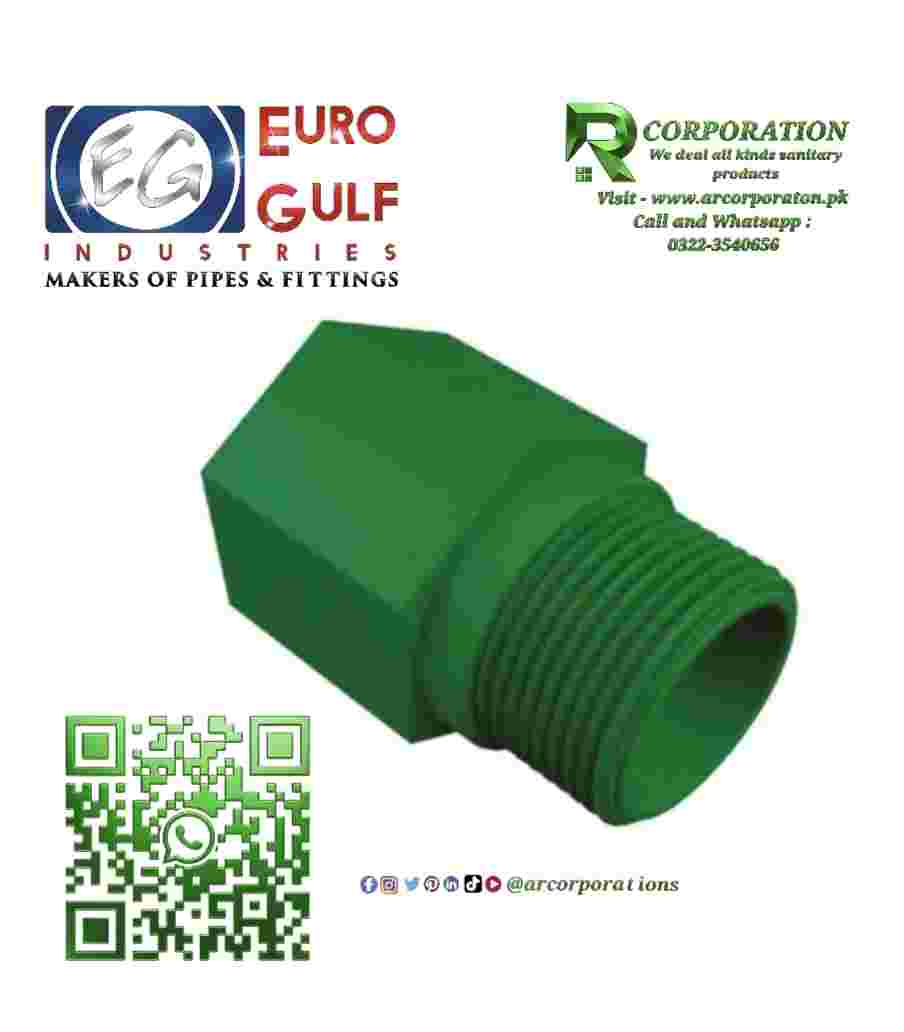
Description
Plug 3/4″
EG PPRc pipes and fittings local ,, Food Grade, Plumbing Materials, Plug 3/4″ EG PPRc Suppliers in karachi Contact 0321-2248975,
What is Plug 3/4″ EG PPRc ?
A 3/4″ PPR-C PN25 plug is a pipe fitting used to close off or cap the end of a PPR-C (Polypropylene Random Copolymer) plumbing line.
It’s typically used in hot & cold water supply systems and HVAC applications where a line needs to be sealed — either permanently or temporarily — for maintenance, future expansion, or pressure testing.
Breakdown of the name:
| Term | Meaning |
|---|---|
| 3/4″ | Nominal size of the threaded connection — common for many residential plumbing systems |
| PPR-C | Material: Polypropylene Random Copolymer — a high-quality plastic used for drinking water & heating lines |
| PN25 | Pressure rating: 25 bar (at 20 °C) suitable for high-pressure hot & cold water systems |
| Plug / EG | A fitting that plugs (caps) the pipe — EG often means end plug or external threaded plug |
🧱 Material & Standards
-
Material: PPR-C (Polypropylene Random Copolymer) — food grade, non-toxic, corrosion-resistant.
-
Pressure Rating: PN25 — meaning it’s built for up to ~25 bar at ~20 °C. At higher temperatures (like ~70–95 °C in hot water), the continuous pressure capacity is reduced per thermoplastic material behavior.
-
Temperature Range: Typically usable from cold up to ~95 °C (hot water).
-
Standards: DIN 8077 / DIN 8078 / ISO 15874 series for PPR plumbing systems.
PPR-C material has a smooth inner surface, resists corrosion and scaling, and won’t rust — ideal for potable water.
🔍 Description & How It Works
A PPR-C plug typically has:
-
One end sized to fit into a PPR pressure pipe (socket) via heat fusion or a threaded adapter.
-
A 3/4″ threaded male end (external) — often BSP type — so you can screw it into a female threaded fitting (like a female adapter, union, tee, or valve).
The plug blocks the flow at that point — meaning:
✔️ You can cap a line temporarily during testing (e.g., high-pressure testing before startup)
✔️ You can close off unused branches
✔️ You can seal an open system end after completion
🧪 Specifications Summary (Typical)
| Feature | Typical Value |
|---|---|
| Size | 3/4″ threaded end |
| Material | PPR-C (Polypropylene Random Copolymer) |
| Pressure Rating | PN25 (25 bar at 20 °C) |
| Temperature Range | ~-20 °C to 95 °C |
| Connection Type | Threaded male plug into female threaded fitting |
| Use Case | Capping ends of pressurized hot/cold water lines |
| Applicable Standards | DIN 8077 / DIN 8078 / ISO 15874 |
| Typical Color | Green (industry standard) |
Note: Exact spec sheets vary by manufacturer but most PN25 PPR-C systems follow the same international standards.
🛠️ Installation — Step by Step
✅ 1. Identify Closure Point
Determine where the pipe needs to be capped — either after cutting the pipe or at a joiner.
✅ 2. Prepare Pipe End
If you’re plugging the end of a PPR-C pipe, ensure the end is clean, square, and free of burrs.
✅ 3. Add a Threaded Female Adapter (if needed)
Since a plug has a threaded male end:
-
Install a female threaded adapter or union onto the PPR pipe using heat fusion socket welding. This gives a female BSP thread for the plug to screw into.
✅ 4. Seal Using Thread Tape / Sealant
Wrap the plug’s threads with PTFE tape or another approved thread sealant to prevent leaks.
✅ 5. Screw in the Plug
Hand-tighten the plug into the female fitting, then use a wrench to snug (but not overtighten). Since the system will be pressurized, thread sealing is crucial.
✅ 6. Pressure Test
Before commissioning the system:
-
Conduct a pressure test (hydro test) per local plumbing or HVAC code.
-
PN25 allows safe pressurized testing beyond working pressure during commissioning (often 1.5× operational).
🚿 Usage & Applications
🧰 Hot & Cold Water Supply
Plugs are used in hydronic hot and cold water systems where pipe ends need to be closed:
-
End of a distribution line
-
Branch line that’s not yet in use
-
During system pressure testing
PPR-C fittings resist corrosion and are suitable for potable water.
🌀 HVAC Applications
In heating/cooling systems, particularly:
-
Return lines or flushing points
-
Temporary closures during maintenance
-
Filling & flushing taps before connecting valves
PPR-C withstands moderate temperatures seen in HVAC loops, though always confirm working temperature vs. design.
🏢 Commercial & Industrial Projects
Used wherever PPR-C piping exists for:
-
Residential & commercial plumbing
-
Central heating systems
-
Roof tanks and risers in multi-story buildings
-
HVAC secondary circuits (chilled water, hot water)
📌 Best Practices & Tips
✅ Always follow the manufacturer’s instructions for heat fusion and installation.
✅ Use certified PN25 fittings where pressure and temperature requirements are high.
✅ For hot systems, derate PN25 working pressure per temperature — e.g., around 8–10 bar at high temperature vs. 25 bar at 20 °C.
✅ Ensure expansion loops/clamps are used in long runs to manage thermal expansion.
✅ Always perform a pressure test after assembly before putting the system into regular use.

Reviews
There are no reviews yet.