
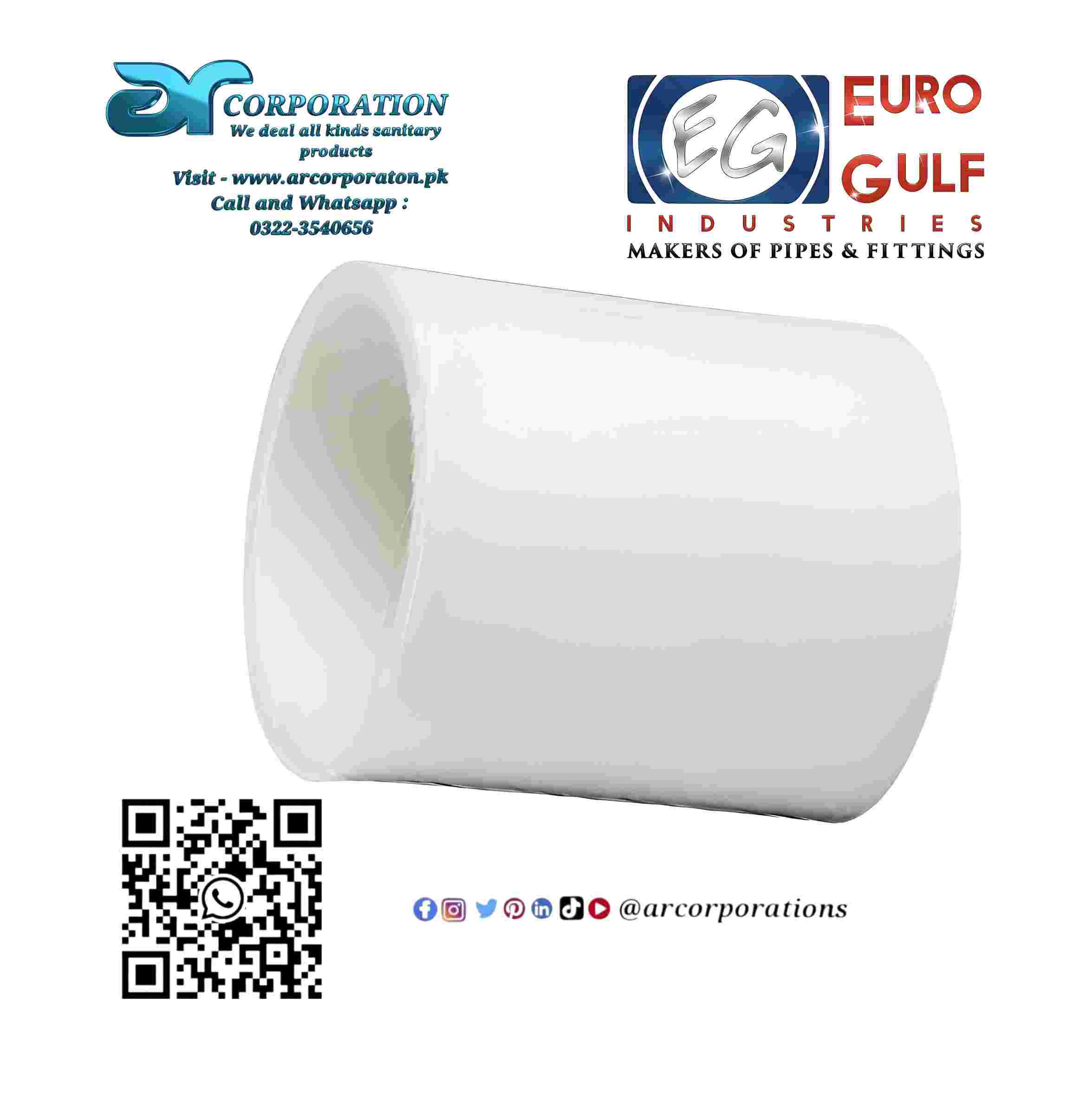
Description
upvc Socket 2″
Euro Gulf local Manufacturer Suppliers in Karachi Contact 0321-2248975 ASTM uPvc Sch-40 Pressure Fittings, Drain sewer ventilation
What is Euro Gulf upvc Socket 2″ ?
The Euro Gulf uPVC Socket 2″ Sch 40 (also known as a Plain Socket or Coupling/Socket Fitting) is a plumbing fitting manufactured by Euro Gulf Industries (Pvt.) Ltd., a Pakistani company specializing in polymer pipes and fittings including uPVC, PPR-C, PE, and cPVC products.
This is a plain socket (slip x slip coupling) designed to connect two straight sections of 2-inch uPVC pipe end-to-end using solvent cement welding. It is part of their Schedule 40 uPVC fittings line, which conforms to ASTM D2466 standards for pressure-rated PVC fittings.
Description
- Type: Plain Socket / Coupling (Slip x Slip) – both ends are smooth sockets (female) for inserting and gluing pipe.
- Material: Un plasticized Polyvinyl Chloride (uPVC or UPVC), a rigid, durable thermoplastic.
- Color: Typically white (common for Schedule 40 uPVC fittings).
- Purpose: Joins two lengths of compatible 2″ Sch 40 uPVC pipe seamlessly in pressure or non-pressure systems. It creates a strong, leak-proof joint when properly installed with solvent cement.
- General Benefits (from Euro Gulf uPVC systems): Corrosion-resistant, lightweight, easy and quick installation, low maintenance, reduced jointing/labor costs, long service life, smooth inner walls for better flow, and resistant to chemicals.
Specifications
- Nominal Size: 2 inches (approximately 50 mm nominal).
- Schedule: Sch 40 (thicker wall for pressure applications compared to thinner schedules like SDR series).
- Standards: ASTM D2466 (for socket-type PVC fittings for pressure applications).
- Material: uPVC (UPVC) conforming to relevant ASTM grades (e.g., cell class per ASTM D1784).
- End Type: Slip x Slip (socket ends for solvent weld; no threads).
- Maximum Operating Temperature: 140°F (60°C) – typical for Schedule 40 PVC/uPVC pressure fittings; pressure rating decreases at higher temperatures.
- Pressure Rating: For Sch 40 PVC at 73°F (23°C), often around 280–300 psi for 2″ size (varies slightly by exact manufacturing; de-rates with temperature – consult exact Euro Gulf data if needed for critical use).
- Applications Suitability: Primarily for cold water supply, drainage, irrigation, industrial fluids, ventilation, and HVAC systems (e.g., condensate drains, chilled water lines where temperatures stay below 60°C). uPVC is not suitable for continuous hot water supply above ~60°C (for hot water, Euro Gulf recommends their cPVC or PPR-C lines, which handle higher temperatures). It can be used in mixed hot/cold systems for cold lines or low-temp chilled water in HVAC.
Installation
uPVC Sch 40 fittings like this socket use solvent cement welding (a chemical bonding process, not heat welding):
- Cut pipe squarely and deburr/clean ends.
- Dry fit to check alignment.
- Apply primer (optional but recommended for better bond) to pipe end and socket interior.
- Apply solvent cement (uPVC-specific, e.g., heavy-body cement) evenly to both surfaces.
- Insert pipe fully into socket with a quarter-turn twist for even distribution.
- Hold for 30 seconds (longer in cold weather).
- Allow cure time (typically 15–30 minutes handling, full pressure cure 24 hours; follow cement manufacturer instructions).
- Avoid pressure testing until fully cured.
- Tools needed: Pipe cutter, chamfer tool, applicator brush, solvent cement/primer.
- Quick & easy compared to metal systems – no threading or soldering.
- Ensure compatibility: Use with Euro Gulf or ASTM D2466-compliant Sch 40 uPVC pipe (same OD ~2.375 inches for 2″ nominal).
Usage
- HVAC: Commonly for condensate drainage lines, ventilation ducts, or chilled water supply/return in low-temperature systems (not high-temp hot water loops).
- Hot and Cold Water Supply: Best for cold water distribution in residential, commercial, or industrial settings. For hot water, limit to low-temp applications or use Euro Gulf’s dedicated hot-water products (cPVC for up to ~180°F or PPR-C for higher).
- Other Common Uses: Potable water (if NSF/approved), irrigation, chemical transport (resistant to many acids/bases), sewer/drainage, and industrial piping.
- Advantages in These Applications: No corrosion (unlike metal), no scale buildup, lightweight (easy handling), and cost-effective for large-scale installations.

Reviews
There are no reviews yet.