
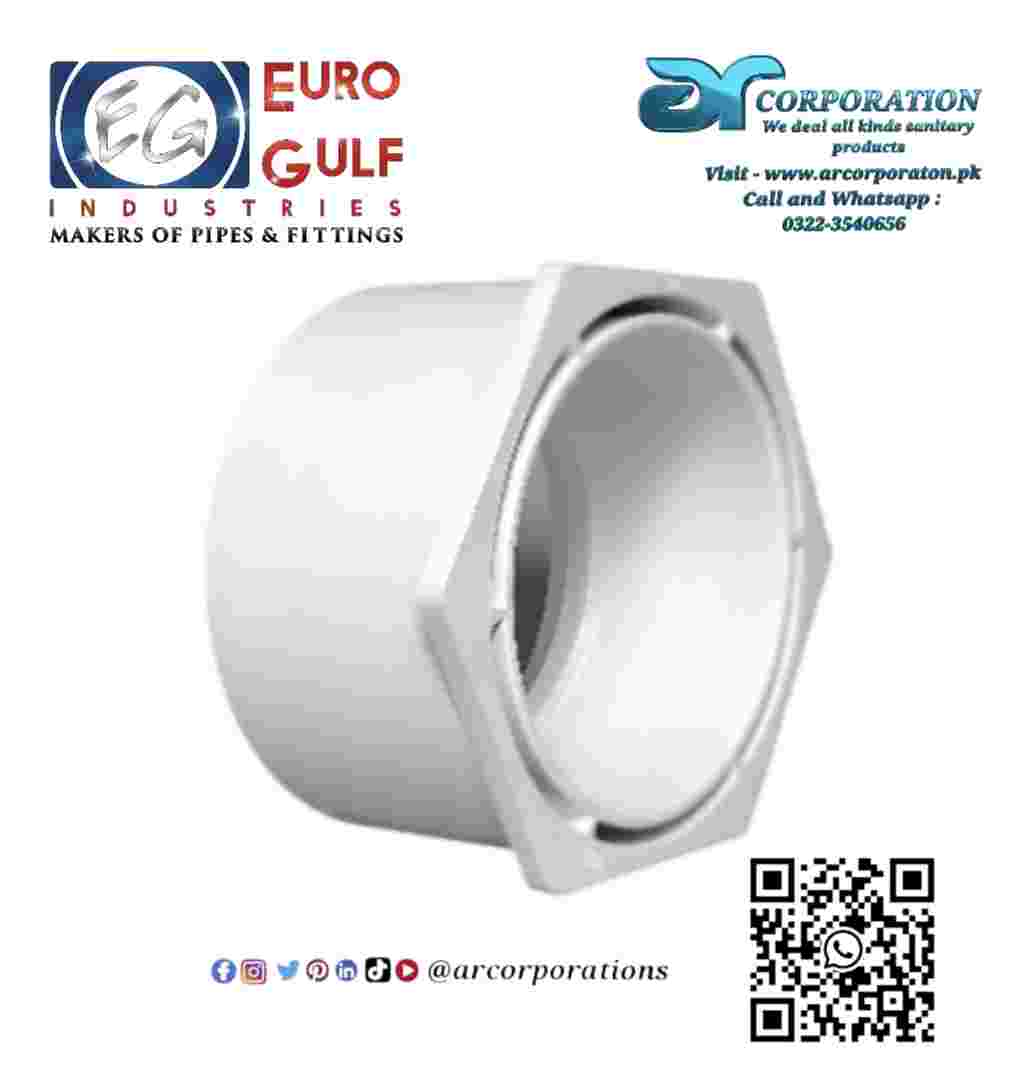
Description
upvc Red Bush 4×3″
Euro Gulf local Jaddah Suppliers in Karachi Contact 0321-2248975. manufacturing standard ASTM D-2665 uPvc Sch-40 Pressure Fittings, Drain sewer ventilation
What is Euro Gulf upvc Red Bush 4×3″ ?
Euro Gulf uPVC Red Bush 4×3″ SCH-40 — a common reducer fitting used in plumbing and piping systems (often applied in HVAC, water supply & drainage). While Euro Gulf’s specific datasheet isn’t widely published online, its fitting type and function are standardized across most uPVC SCH-40 reducer bushes.
📌 What Is Euro Gulf uPVC Red Bush 4×3″ SCH-40?
A uPVC (Unplasticized Polyvinyl Chloride) Reducing Bush is a rigid plastic pipe fitting that connects two pipes of different diameters — in this case 4-inch to 3-inch.
-
The “Red Bush” term refers to reducer fitting.
-
SCH-40 (Schedule 40) indicates a standard wall thickness and pressure handling capacity.
-
It’s typically used in pressure piping systems, including water distribution, HVAC condensate return, irrigation, and general fluid conveyance.
🧱 Material & Standards
Material:
-
uPVC (Unplasticized Polyvinyl Chloride) – a rigid, durable thermoplastic with excellent corrosion and chemical resistance.
Typical Standards: (varies by manufacturer but generally applicable)
-
ASTM D2466 / D2665 – for uPVC pressure fittings.
📏 Key Specifications Euro Gulf upvc Red Bush 4×3″
| Attribute | Details |
|---|---|
| Fitting Type | Reducing Bush (Reducer) |
| Size | 4″ (larger end) × 3″ (smaller end) |
| Material | uPVC |
| Schedule | SCH-40 (standard wall thickness) |
| End Type | Socket/Smooth bore (for solvent welding) |
| Color | Often white/grey (Euro Gulf branded may vary) |
| Max Service Temperature | Up to ~60 °C (140°F) typical limit for standard uPVC SCH40 fittings — see installation notes below. |
| Corrosion Resistance | Excellent (water, many chemicals, non-corrosive) |
📌 What It Does (Function)
A reducing bush has two primary functions:
-
Size Transition
Connects a larger pipe (4″) to a smaller pipe (3″) in the same line. This allows different pipe sizes to be used without additional adapters. -
Smooth Flow Transition
Reducing the bore size gently (compared to a sudden step) helps maintain better flow dynamics and reduces turbulence in fluid systems.
🔧 Typical Applications
Cold & Hot Water Supply (Non-CPVC)
For ordinary potable / utility water lines where temperature stays within uPVC limits (~60 °C).
HVAC Systems
Used in condensate drain lines or non-pressure return lines, where pipe size reduction is needed.
Plumbing & Irrigation
Residential, commercial, industrial water distribution.
Drainage & Sewage
Sometimes used for low-pressure wastewater applications (check local codes).
🔩 Installation — Step-by-Step
IMPORTANT: uPVC fittings like this are typically joined by solvent welding (chemical bonding), not threaded assembly.
1. Prepare the Pipes
-
Cut the pipe ends squarely (no angle).
-
Deburr and clean both pipe ends and fitting sockets.
2. Dry Fit
-
Insert both the 4″ and 3″ pipes into the respective sides of the reducer to check alignment before gluing.
3. Apply Solvent Cement
-
Use uPVC solvent cement compatible with SCH-40 fittings.
-
Apply a thin, even coat to both the pipe end and fitting socket.
4. Assemble
-
Insert the pipes into the fitting and push firmly until fully seated.
-
Hold in place for 20–30 seconds until initial set.
5. Cure & Pressure Test
-
Let the joint cure (typically 15–30 min for handling; full cure ~24 h).
-
Pressure test before final commissioning to verify leak-free joints.
✅ Advantages of uPVC Reducer Bushes
✔ Corrosion & Chemical-Resistant: No rust, long service life in water systems.
✔ Lightweight & Easy to Install: Faster work than metal fittings.
✔ Leak-Resistant Bonds: Solvent-welded joints provide durable seals.
✔ Economical: Lower cost than many metal alternatives.
⚠️ Temperature & Pressure Notes
-
Standard uPVC SCH-40 is commonly rated for cold and moderately warm water (up to ~60 °C).
-
For high-temperature hot water over ~60 °C, consider CPVC fittings (chlorinated PVC) designed for hot water service.
-
Always consult local codes and manufacturer datasheets for allowable pressure vs. temperature limits.

Reviews
There are no reviews yet.