
Description
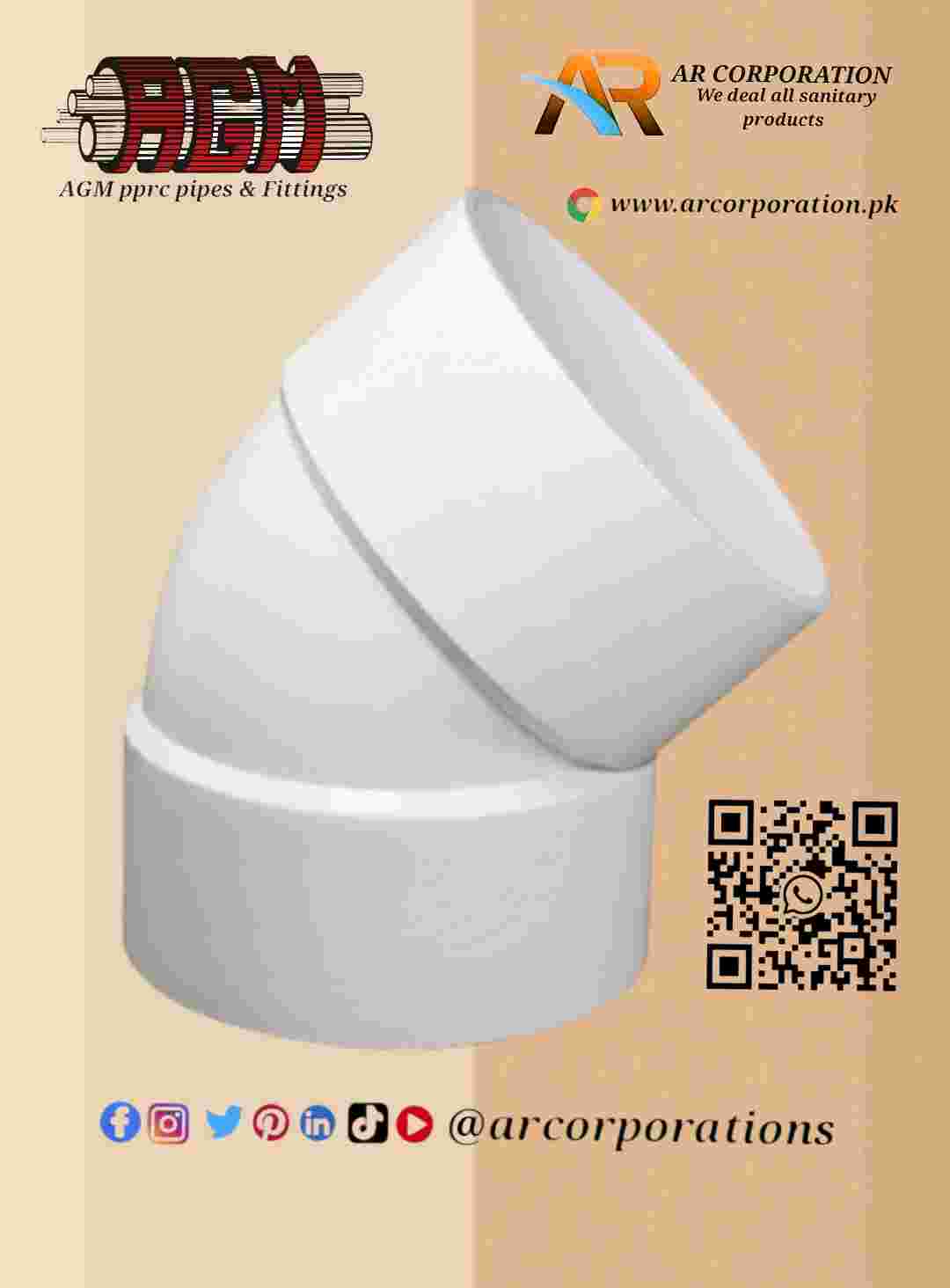
upvc Elbow 8″ 45* agm
AGM imported from Saudi Arab ASTM uPvc Sch-40 Pressure Fittings, Drain sewer ventilation. imported material in Karachi 0322-3540656
What is agm upvc Elbow 8″ 45*
-
A pipe fitting made of un plasticized polyvinyl chloride (UPVC).
-
8-inch nominal size with a 45-degree angle bend.
-
Schedule 40 (SCH-40) denotes a standard wall thickness and pressure rating class.
-
Manufactured to ASTM standards (common in Saudi Arabia and abroad).
-
Imported brand: AGM (Arabian Gulf Manufacturers Ltd.) from Saudi Arabia.
🧱 Material & Construction
Material:
-
Un plasticized Polyvinyl Chloride (UPVC / PVC-U) — a rigid, strong thermoplastic.
-
UPVC is non-flexible (hence “un plasticized”), giving high structural strength and long life.
Physical Traits:
-
Smooth inner surface → low friction & better flow.
-
Corrosion-resistant → no rust or scale formation.
-
Resistant to many chemicals found in wastewater/sewer effluent.
Color: White (typical for potable water and drainage fittings).
🔩 Specifications
Here’s what typical UPVC SCH-40 elbows like the AGM product conform to:
| Feature | Detail |
|---|---|
| Size | 8″ nominal diameter |
| Angle | 45° bend |
| Material | UPVC (Un plasticized PVC) |
| Schedule | SCH-40 – standard wall |
| Standards | ASTM for UPVC fittings (commonly ASTM D2466 / D2665) |
| Connection Type | Socket (slip) ends for solvent welding |
| Color | White |
| Origin | Saudi Arabia (AGM brand) |
Note: Exact dimensions (like outer diameter, wall thickness) follow international SCH-40 tables for an 8″ UPVC fitting, but these should be verified from manufacturer data sheets for precision.
🧠 How It Works
A 45° elbow fitting is used to change the direction of a pipeline by 45 degrees.
Compared to a 90° elbow, the 45° version causes less resistance and turbulence and is often used where smoother flow or gentler direction change is beneficial (e.g., drainage, HVAC condensate lines, sewer venting).
🔧 Installation Guide
Tools & Materials Needed
-
UPVC solvent cement (glue)
-
Pipe cutter or saw
-
Deburring tool or sandpaper
-
Measuring tape
Steps
-
Cut pipe ends squarely to the required length.
-
Deburr and clean pipe edges and fitting sockets.
-
Apply UPVC primer (if required) around the pipe end and inside the socket.
-
Apply solvent cement to both the pipe end and socket interior.
-
Insert the pipe fully into the elbow socket with a twisting motion.
-
Hold in place for the time recommended by the cement manufacturer.
-
Wipe excess cement and allow curing before pressure testing.
✔ Ensure a tight connection by following the cement manufacturer’s temperature and cure-time instructions.
⚙️ Common Usage & Applications
Sewerage & Wastewater
-
Ideal for drainage and sewer lines where a slight directional shift is needed.
-
Good corrosion resistance in wastewater environments.
Water Supply
-
For cold potable and raw water distribution pipelines.
-
Common in gravity or low-pressure systems.
HVAC & HVAC Drainage
-
Used in condensate drain piping and HVAC liquid vent lines.
-
Supports routing around obstacles and transitions in HVAC duct / plumbing layouts.
Other Uses
-
Irrigation, landscape drainage, gutter/drain piping systems.
🧭 Advantages
✅ Corrosion & chemical resistance — no rusting in wet conditions.
✅ Lightweight & easy to install — quicker to place than metal alternatives.
✅ Cost-effective — generally cheaper than metal.
✅ Long lifespan when installed correctly.
✅ Smooth bore for efficient fluid movement.
⚠️ Limitations & Considerations
🔹 Not suitable for hot water applications above ~60 °C (UPVC softens).
🔹 Cannot withstand very high pressures like Schedule 80 or metal fittings.
🔹 Require correct solvent welding — improper joins can leak.
🔹 Do not use for compressed air or gas lines.
🧰 Installation Tips
-
Always check local codes — some jurisdictions require primer and specific solvent types.
-
Perform a pressure test after installation before service.
-
Avoid excessive bending force on fittings — let the elbow take the curve.

Reviews
There are no reviews yet.