
Description
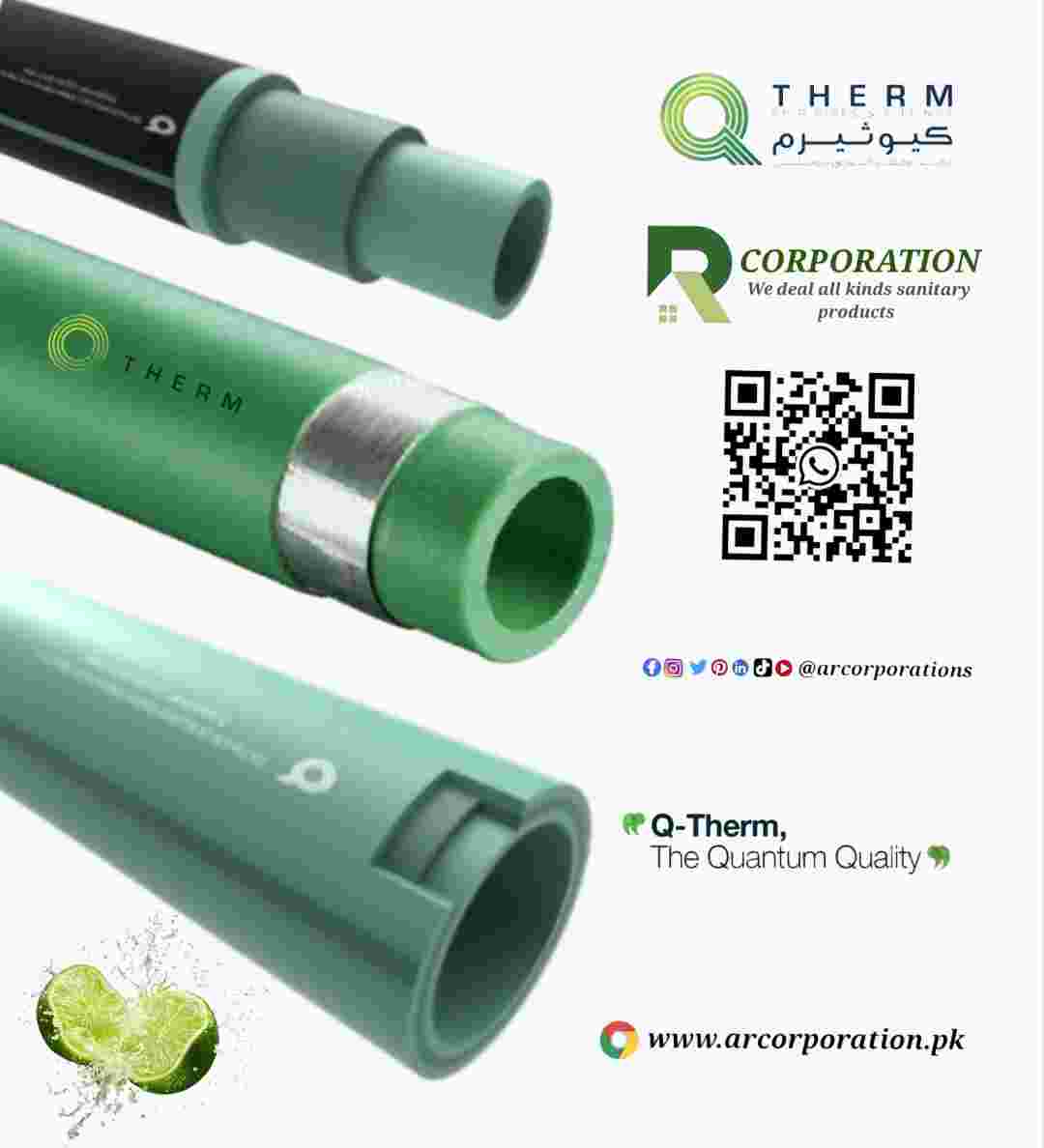
PPR Pipe 25mm 3 layers
PN 25 imported from UAE for hot and cold Q-therm PPRc pipes and fittings , Food Grade, Plumbing Materials. PPR Pipe 25mm 3 layers distributor 0322-3540656
What is PPR Pipe 25mm 3 layers Q-Therm imported ?
Specifications
The following table provides key technical specifications for the Q-Therm 3-Layer PPR Pipe 25mm PN 25, based on Q-Therm product details and compliance with standards like DIN 8077/8078 and ISO 15874:
| Parameter | Details |
|---|---|
| Nominal Diameter (OD) | 25mm (outer diameter) |
| Wall Thickness | ~3.5–4.2mm (varies by layer configuration) |
| Pressure Rating (PN) | 25 (25 bar at 20°C for cold water; derates for hot water) |
| Material | Outer/Inner: PP-R Type 3; Middle: Aluminum or Fiberglass reinforcement |
| Temperature Range | -20°C to +95°C (suitable for hot and cold water; derates with temperature) |
| Layer Structure | 3 layers (PP-R / Reinforcement / PP-R) |
| Standards Compliance | DIN 8077/8078, ISO 15874, EN ISO 21003 (for multilayer pipes) |
| Color | Typically green (hot water) or gray (cold water); may have stripes |
| Thermal Expansion | ~0.03–0.05 mm/m/°C (reduced due to reinforcement layer) |
| Service Life | Minimum 50 years under PN 25 at 20°C |
| Weight (approx.) | 0.20–0.25 kg/m (lightweight for easy handling) |
| Length | Standard 4m or 6m lengths (customizable per supplier) |
| Thermal Conductivity | ~0.21 W/m·K (low, reducing heat loss in hot water systems) |
Note: The pressure rating decreases with temperature (e.g., ~10 bar at 60°C, ~5 bar at 80°C). Consult the manufacturer’s pressure-temperature chart for precise derating. The middle layer (aluminum or fiberglass) enhances UV resistance and reduces thermal expansion compared to single-layer PPR pipes.
Usage
The Q-Therm 3-Layer PPR Pipe 25mm PN 25 is versatile and widely used in various applications due to its robust construction and resistance to high temperatures and pressures:
- Domestic Plumbing: Hot and cold potable water supply in residential buildings, apartments, and villas.
- Commercial and Industrial Systems: Water distribution in hotels, hospitals, schools, and factories, including compressed air lines and chemical fluid transport.
- Heating and Cooling Systems: Radiant floor heating, underfloor heating, and chilled water systems due to low thermal conductivity and high temperature tolerance.
- High-Rise Buildings: Popular in regions like Karachi for multi-story constructions, where pressure and temperature stability are critical.
- Outdoor Installations: The reinforcement layer provides UV resistance, making it suitable for partially exposed installations (with proper insulation).
Its smooth inner surface prevents scaling, corrosion, and bacterial growth, ensuring long-term hygiene and flow efficiency. The pipe is not recommended for direct gas transport or applications exceeding 95°C without manufacturer approval.
Installation
Installation of the Q-Therm 3-Layer PPR Pipe 25mm PN 25 requires socket fusion welding or electrofusion, depending on the fittings used (e.g., 25mm Q-Therm sockets, elbows, or tees). Below is a step-by-step guide for socket fusion, the most common method:
- Preparation:
- Cutting: Use a PPR pipe cutter to cut the pipe squarely to the desired length, ensuring a clean, perpendicular edge.
- Cleaning: Clean the pipe ends and fitting surfaces with alcohol or a dry cloth to remove dirt, grease, or moisture.
- Chamfering: Bevel the pipe edge slightly (using a chamfering tool) to ease insertion into fittings.
- Marking: Mark the insertion depth (typically 25–30mm for 25mm pipes) to ensure proper fusion.
- Heating:
- Preheat a PPR fusion welding machine to 260–280°C (standard for PPRc).
- Simultaneously insert the pipe end into the heating bush and the fitting (e.g., Q-Therm 25mm socket) into the corresponding heating socket.
- Heat for 10–15 seconds (exact time depends on ambient conditions; use a timer to avoid overheating).
- Fusion:
- Quickly remove the pipe and fitting from the heater and insert the pipe into the fitting to the marked depth.
- Apply even, firm pressure for 10–20 seconds to form a uniform weld bead around the joint.
- Allow the joint to cool undisturbed for 10–15 minutes (longer in colder environments) to ensure bond strength.
- System Assembly and Testing:
- Secure pipes with clips or hangers every 50–70cm to prevent sagging, accounting for thermal expansion (lower in 3-layer pipes but still ~0.03 mm/m/°C).
- Use protective sleeves or insulation for pipes embedded in walls or floors to allow movement and protect against abrasion.
- Pressure-test the system at 1.5 times the operating pressure (e.g., 37.5 bar for PN 25 at 20°C) for 1–2 hours to check for leaks.
- Avoid sharp bends (minimum bend radius: 5x diameter); use appropriate fittings (e.g., elbows) for turns.
- Tools and Safety:
- Required Tools: PPR fusion machine, pipe cutter, chamfering tool, measuring tape, and depth gauge.
- Safety Precautions: Wear gloves and safety glasses; work in a well-ventilated area to avoid inhaling fumes from heated PPR.
- Insulation: For hot water or outdoor installations, apply foam or fiberglass insulation to minimize heat loss or UV damage.
- Best Practices:
- Follow Q-Therm’s technical manual for precise fusion times and temperatures.
- Ensure compatibility with Q-Therm fittings (e.g., 25mm sockets, reducers) for leak-proof joints.
- Avoid over-tightening threaded connections (if used with PPR-to-metal adapters).
- Engage certified installers for large-scale or high-pressure systems to ensure compliance with standards and warranty terms.
Additional Notes
- Warranty: Q-Therm typically offers a 50-year service life guarantee under specified conditions (PN 25 at 20°C). Improper installation or exposure to unsupported conditions (e.g., excessive UV or temperatures >95°C) may void this.
- Availability: Available through authorized distributors in regions like Pakistan (e.g., Karachi, Lahore) and the Middle East. Check with suppliers for pricing and stock.
- Environmental Benefits: PPR is recyclable, and the 3-layer design reduces material waste while enhancing performance.
- Maintenance: Virtually maintenance-free due to corrosion resistance; periodic checks for joint integrity are recommended in high-pressure systems.

Reviews
There are no reviews yet.