
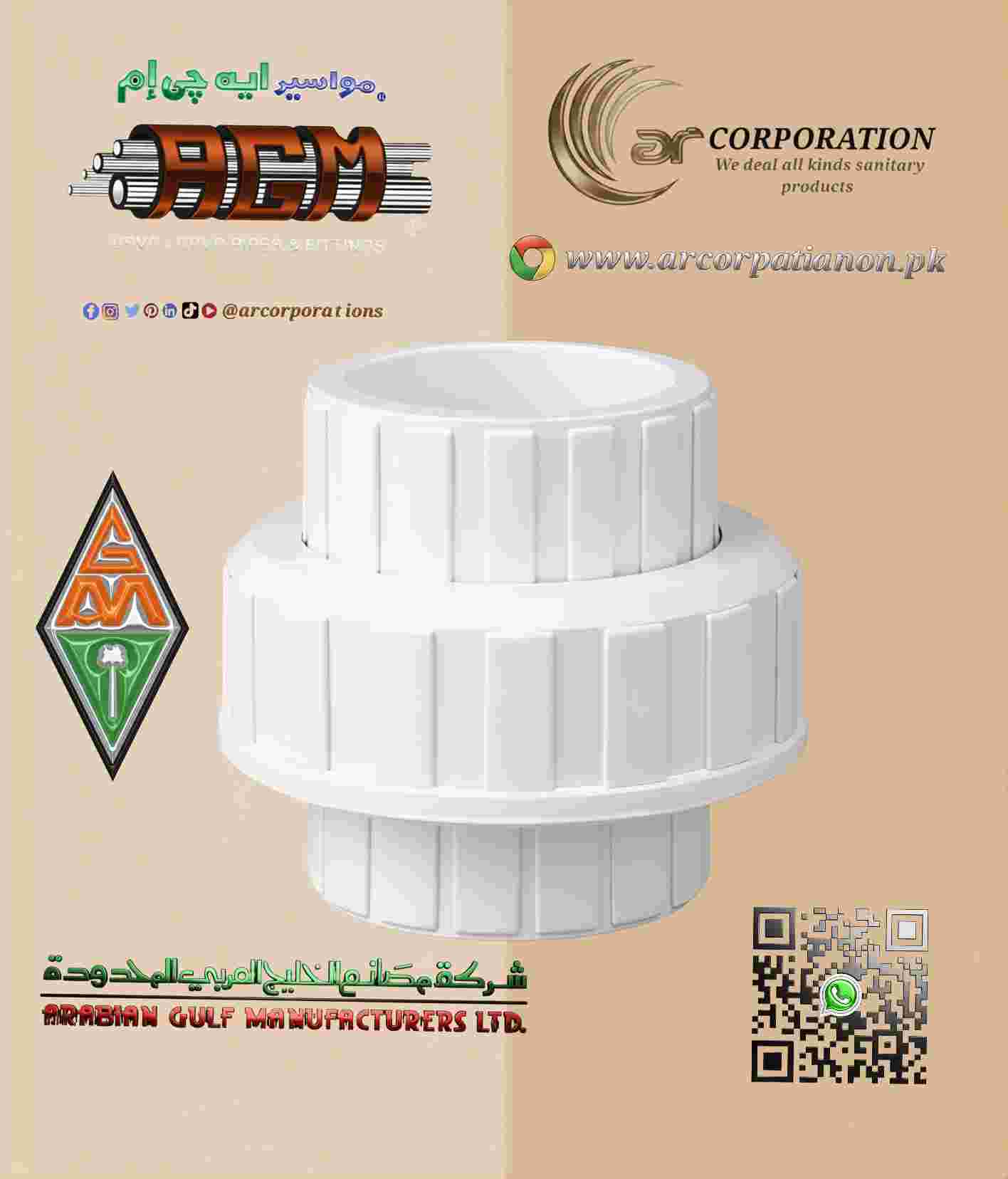
Description
upvc Union 1″ AGM
AGM imported from Saudi Arab ASTM uPvc Sch-40 Pressure Fittings, Drain sewer ventilation. importer supplier contact 0322-3540656
What is AGM upvc Union 1″ ?
-
The AGM UPVC Union 1″ Schedule 40 is a key fitting for creating a serviceable and demountable joint in Unplasticized Polyvinyl Chloride (UPVC) piping systems, particularly those used for water supply and sewerage.
Based on the details provided and general industry standards for fittings made by Arabian Gulf Manufacturers Ltd. (AGM) in Saudi Arabia, here is a detailed breakdown:
🇸🇦 Product Details: AGM UPVC Union 1″ Sch 40
Attribute Detail Manufacturer Arabian Gulf Manufacturers Ltd. (AGM) Origin Saudi Arabia (Manufactured in KSA) Material Unplasticized Polyvinyl Chloride (UPVC or PVC-U) Nominal Size 1 Inch Schedule Schedule 40 (SCH 40). Standard wall thickness for non or medium-pressure applications. Fitting Type Union. A three-piece fitting designed for connecting two pipes or fittings without requiring either pipe to be turned. Connection Ends Typically Socket (Slip) x Socket (Slip), requiring solvent cement on both ends to attach to the pipe. Sealing Mechanism Includes a central threaded ring with an internal elastomeric seal (O-ring, often EPDM or Buna-N) to ensure a watertight and leak-proof joint when tightened. Standards Conforms to international standards like ASTM D2466/D2665 (for SCH 40 PVC fittings) and likely includes certification for potable water applications (e.g., NSF/ANSI 61). Color Commonly White for SCH 40 pressure fittings in this region.
📝 Description and Specifications
The UPVC Union is an essential component when a section of piping must be removable for maintenance, repair, or future modification without having to cut the pipe or replace long runs.
Key Features and Specifications
-
Demountable Joint: The primary function is to provide a quick, simple way to disconnect and reconnect the pipeline by simply unscrewing the central nut, while the two pipe ends (the “tail pieces”) remain permanently solvent-welded to the pipe.
-
Corrosion and Chemical Resistance: UPVC is highly resistant to corrosive elements commonly found in water supply and sewerage, including mild acids, alkalis, and salts.1
-
Pressure Rating: For a 1-inch Schedule 40 UPVC fitting, the maximum rated water pressure at $73^{\circ}\text{F}$ ($23^{\circ}\text{C}$) is typically around 450 PSI (Pounds per Square Inch). This value reduces significantly as the operating temperature increases, with a maximum service temperature of approximately $140^{\circ}\text{F}$ ($60^{\circ}\text{C}$).
-
Applications:
-
Water Supply: Used just upstream or downstream of pumps, filters, water heaters, and storage tanks.2
-
Sewerage/Drainage (DWV): Used where periodic cleaning or access to equipment is required.
-
Irrigation/Pools: Facilitating the removal of components like pumps, chlorinators, or heaters.
-
🛠️ Installation and Usage
The installation of a UPVC Union involves permanently bonding the two tail pieces to the pipe using solvent cement, and then securing the joint with the central nut and O-ring.
Usage
The union is designed to be installed at a point in the pipeline where a disconnect point is necessary. Once installed, the central threaded ring can be loosened to separate the two halves of the pipe, providing access without disrupting the rest of the system. The O-ring within the union creates the watertight seal.
Installation Steps (Solvent Weld)
-
Preparation and Cutting: Cut the 1-inch UPVC pipe square (at 3$90^{\circ}$).4 Use a deburring tool or file to remove all burrs from the inside and outside of the pipe ends and lightly bevel the edges.5
-
Dry Fit: Disassemble the union into its three parts (two tail pieces and the central nut). Dry-fit the tail pieces onto the pipe ends to ensure they fit correctly and fully seat into the socket.
-
Nut Placement: Crucially, slide the central threaded nut onto one of the pipe ends before applying primer or cement.
-
Primer Application (Recommended): Apply a coat of UPVC primer to the outside of the pipe end and the inside of the union tail piece socket.6 Primer softens the plastic for a stronger chemical weld.7
-
Solvent Cement Application: Apply an even, heavy coat of UPVC solvent cement to the outside of the pipe end and a thin coat to the inside of the union tail piece socket.8
-
Assembly (Weld): Immediately push the pipe fully into the tail piece socket with a slight 9$1/4$ turn to distribute the cement evenly.10 Hold firmly for about 30 seconds to prevent “push-out.”11 Repeat for the second tail piece.
-
Curing: Allow the solvent-welded joints to cure as per the cement manufacturer’s instructions (usually 15-30 minutes for initial set, and 24 hours before applying full system pressure).12
-
Final Assembly: Once cured, ensure the O-ring is properly seated inside the central nut or one of the tail pieces. Bring the two tail pieces together and screw the central nut over the threads. Hand-tighten the nut firmly to compress the O-ring and create the final leak-proof seal. Do not use a wrench on the plastic nut, as overtightening can crush the O-ring or crack the union body.
.
-

Reviews
There are no reviews yet.