
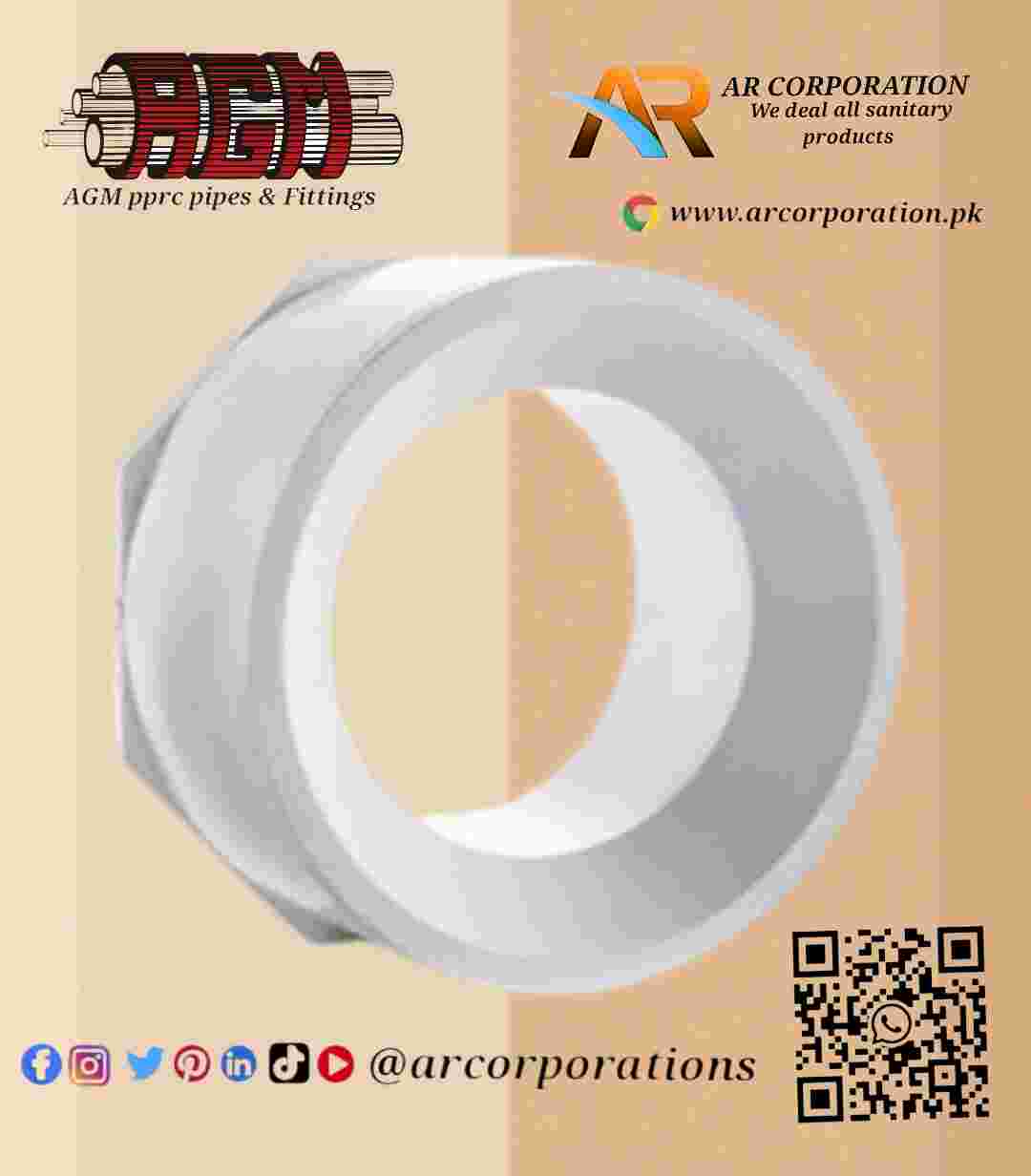
Description
upvc reducer bush 4×2
AGM imported from Saudi Arab ASTM uPvc Sch-40 Pressure Fittings, Drain sewer ventilation. online shop contact 0322-3540656
What is AGM upvc reducer bush 4×2 ?
uPVC Red Bush 4″×2″ SCH-40 AGM is — how it works, typical specs, installation approach, and common uses (for sewerage / water supply / drainage), based on publicly available data for AGM & general uPVC reducer bushes.
description
-
The “4×2 SCH-40 reducer bush (or “red bush”)” is a reducing bushing (sometimes “reducer bush / reducer bushing / reducer”), manufactured from un plasticized PVC (uPVC / PVC-U), by AGM (imported from Saudi Arabia).
-
It’s used to connect a larger-diameter (4-inch) uPVC pipe or fitting to a smaller-diameter (2-inch) uPVC pipe, by providing a socket for the 4″ side and a smaller socket/spigot for the 2″ side.
-
“SCH-40” denotes the Schedule 40 standard of wall thickness/pressure rating for uPVC — the standard commonly used for water supply, drainage, and general plumbing.
So in short — a straight (non-angled) reducer that reduces a 4″ line down to 2″.
Specifications AGM upvc reducer bush 4×2
Based on AGM’s listing and general uPVC/SCH-40 reducer bush standards:
| Attribute | Typical Detail |
|---|---|
| Material | uPVC (un plasticized PVC / PVC-U) |
| Standard / Schedule | SCH-40 (ASTM standard for socket-joint PVC pressure / DWV fittings, e.g. ASTM D2466, D2665) |
| Size (Nominal) | 4″ → 2″ (Large side 4-inch nominal; Small side 2-inch nominal) |
| Connection Ends | Slip/socket (socket-socket) — for solvent-weld installation with SCH-40 pipe. |
| Color (as listed) | Often “white” (or according to manufacturer color). Some distributor reference mention “white color”. |
| Compatibility | Works with SCH-40 uPVC pipes & fittings (matching schedule / socket dimensions) |
| Pressure / Application Suitability | Suitable for standard plumbing, drainage, sewerage, cold water supply (not for hot water above uPVC temperature limits). General schedule-40 PVC fittings are widely used up to certain pressure/temperature ratings depending on pipe size & installation standards. |
Important note: I didn’t find a publicly available AGM datasheet (in the sources I searched) giving a precise “maximum pressure (bar / psi)” for the 4×2 reducer bush. This is typical — many distributors only list nominal size and fitting type. If pressure rating is critical (e.g. for pressurized water supply), you should ask your supplier for the AGM part-number and corresponding technical datasheet with pressure/temperature rating.
🔧 Installation
Using a 4×2 uPVC reducer bush (SCH-40) generally follows standard solvent-weld uPVC joint procedures:
-
Prepare the pipes: Cut the 4″ and 2″ uPVC pipes square, remove burrs, chamfer/spoke the edges lightly for ease of insertion.
-
Dry-fit: Insert the 4″ side into the reducer bush socket, and 2″ pipe into the smaller socket, to check alignment and depth — ensure proper fit.
-
Solvent cement / primer (if required): Use a uPVC-compatible primer and SCH-40-rated solvent cement. Apply evenly to socket interior and pipe spigot. (Follow cement manufacturer’s instructions / local plumbing code.) Common for SCH-40 fittings.
-
Join pipes: Immediately after applying cement, insert the pipe fully and twist a quarter-turn (or slight rotation) to spread cement and ensure full contact.
-
Hold & cure: Hold joint for manufacturer’s recommended set time; allow full cure before pressure test or putting system in service. Building/codes usually require a curing period before testing or load.
-
System test & inspection: For water supply lines — perform hydrostatic pressure test (as per relevant code or design). For sewer/drain systems — perform leak test or water-fill test as applicable.
-
Support & protection: Provide proper support for piping to avoid undue stress; avoid bending or external loads on reducer bush. If installed underground or exposed, ensure proper bedding/cover for pipe stability.
Applications
A 4×2 SCH-40 uPVC reducer bush from AGM (or equivalent) is typically used for:
-
Drainage / sewerage systems — to transition from a larger sewer main (4″) to a smaller branch (2″) or service line; good for building waste / soil stacks, drainage branches, WC or washbasin drain lines where down-size is needed.
-
Cold water supply (non-heated) — in water distribution networks, where flow from a larger main pipe needs to reduce to a smaller line. Good for domestic or light-commercial cold-water systems (assuming the system pressure/temperature is within PVC limits).
-
Vent / rainwater drainage / waste disposal — where a larger pipe downsizes to a smaller pipe for branches, roof drainage, overflow lines, irrigation/drain discharge, etc.
-
Industrial/commercial drainage — if uPVC material is suitable for the fluid (e.g. water, light chemical solutions, non-aggressive fluids), a reducer bush can be used to change pipe diameters in waste / discharge lines.
Limitations / what it’s not for:
-
Not recommended for hot water supply (uPVC generally not rated for high temperature / hot-water — use CPVC or other appropriate material) unless confirmed otherwise. AGM’s SCH-40 uPVC line is for standard cold water / drainage.
-
For aggressive chemicals / very high pressures — need to check chemical compatibility and pressure rating; if not suitable, an industrial-grade fitting (SCH-80, CPVC or compatible material) may be required.
What to Confirm When You Buy
When acquiring or installing a 4×2 AGM uPVC reducer bush, make sure to verify:
-
That it is indeed SCH-40, not some lower-grade / non-pressure / non-standard fitting. (Ask for print/copy of standard — e.g. “AGM SCH-40 Reducer Bush, size 4×2, socket-socket.”)
-
Material is uPVC (PVC-U) and not lower-grade PVC or CPVC (unless CPVC is specified).
-
That the diameter/pipe standard (OD, socket dimensions) matches your existing 4″ and 2″ uPVC pipes.
-
Use of correct solvent cement (uPVC-compatible) and adherence to correct assembly & cure procedures.
-
For water supply — ensure pressure rating and temperature limits of the fitting meet your system requirements.
-
For drainage / sewer line — confirm that system slope, load, support and bedding (if underground) are appropriate to avoid stresses on the reducer.
🎯 Summary
-
You prefer solvent-weld, leak-proof, permanent joint rather than threaded/adaptor systems.
-
The system is cold-water, drainage, sewer, waste or vent — where SCH-40 uPVC is suitable.
-
You want a compact, durable, corrosion-resistant plastic fitting easier to handle and lighter than metal alternatives.

Reviews
There are no reviews yet.