
Description
PPR Pipe 75mm Aluminum Layer
RAKtherm imported PPRc, Food graded third generation Poly propylene Random with Co-polymer
materials. contact 0322-3540656
What is PPR Pipe 75mm Aluminum Layer ?
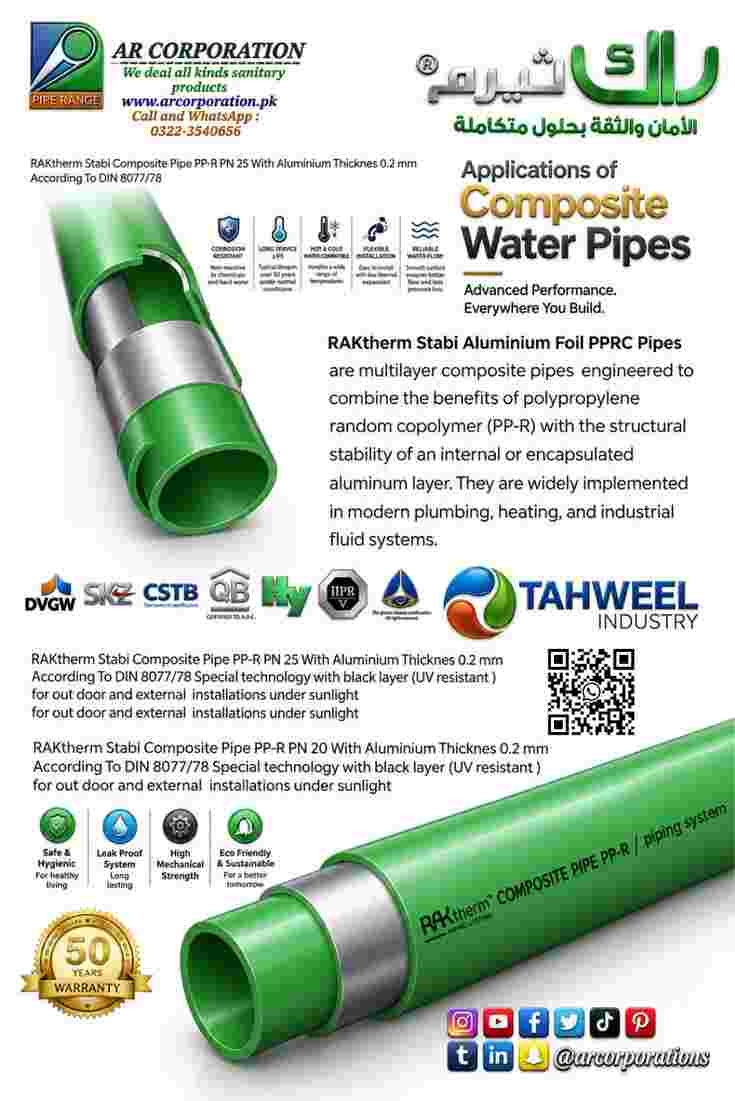
PPR Pipe 75 mm Aluminum Layer Stabi (Raktherm) PN 25 is a three‑layer composite pipe (PP‑R / aluminum / PP‑R) designed for pressurized hot and cold water systems, including HVAC chilled/heating water circuits.
What it is (construction & purpose)
Raktherm “Stabi” pipes are multilayer composite pipes with:
-
Inner layer: PP‑R (polypropylene random copolymer) – smooth, hygienic, corrosion‑resistant bore for potable and HVAC water.
-
Middle layer: Continuous aluminum foil (~0.2 mm) – acts as an oxygen barrier and, critically, reduces linear thermal expansion to near‑metallic levels.
-
Outer layer: PP‑R – protects the aluminum and provides the fusion‑welding surface.
This construction is intended for hot & cold potable water, heating circuits, chilled water, and other HVAC water networks where you want plastic’s corrosion resistance but with much lower expansion and better high‑temperature behavior.
Typical specification for 75 mm PN 25 (Raktherm Stabi)
Exact values can vary slightly by batch/catalog edition, but the following aligns with Raktherm’s PN 25 Stabi range and DIN 8077/78 dimensional series:
-
Nominal size: 75 mm (outside diameter, OD)
-
Pressure class: PN 25 (25 bar nominal at 20 °C; derates with temperature per PN 25 tables)
-
Standard: Manufactured to DIN 8077/8078 (PP‑R pipe dimensions & quality) with aluminum composite construction.
-
Aluminum layer thickness: typically 0.2 mm continuous foil
-
Wall thickness (S): for PN 25 Stabi 75 mm, typically around 10–11 mm total wall (check the specific catalog sheet for the exact “S” value for 75 mm Stabi PN 25).
-
Internal diameter (ID): roughly OD − 2×S → for 75 mm OD and ~10.3 mm wall, ID ≈ 54–55 mm (gives higher flow area than same‑OD standard PP‑R due to optimized wall design.
-
Temperature range: continuous operation up to 70 °C typical; short‑term peaks up to 95–100 °C acceptable depending on pressure and duration (per PN 25 service tables).
-
Linear expansion: reduced by ≥80% vs standard PP‑R due to the aluminum layer, allowing longer unsupported runs and fewer expansion loops in exposed installations.
-
Oxygen tightness: aluminum layer provides very low oxygen permeation, beneficial for closed heating/chilled loops to limit corrosion in metal components.
For procurement, you’ll usually see it listed as:
“Raktherm Stabi Composite Pipe PP‑R/Al/PP‑R, 75 mm, PN 25, DIN 8077/78, Al thickness 0.2 mm, UAE origin.”
Why use it in HVAC water systems PPR Pipe 75mm Aluminum Layer
-
Hot water & heating: Lower expansion means fewer movement joints and less stress on supports and equipment connections in risers and plant rooms.
-
Chilled water: Good for insulated chilled water lines where condensation control and corrosion resistance are priorities; aluminum layer helps maintain dimensional stability under temperature swings.
-
Potable + HVAC crossover: Same pipe family can be used for domestic hot/cold and HVAC makeup/primary circuits, simplifying specs and spares.
-
Corrosion & scaling resistance: PP‑R interior resists scale and corrosion better than many metals in typical building water qualities common in GCC/Pakistan.
Installation overview (fusion welding with peeling)
Raktherm Stabi pipes are joined by socket fusion welding, but because of the aluminum layer you must remove the outer PP‑R and aluminum over the insertion length before welding so the joint is PP‑R to PP‑R.
1) Preparation
-
Storage: Keep pipes out of direct sun for long periods unless using UV‑protected version; store on flat supports, protected from mechanical damage.
-
Cutting: Use a ratchet pipe cutter or fine‑tooth saw to cut square (90°). Deburr and chamfer the outer edge lightly.
-
Mark insertion depth: Using the fitting manufacturer’s chart, mark the welding depth on the pipe (how far it must enter the fitting).
2) Peeling / shaving (critical for Stabi)
-
Use a dedicated Stabi peeling tool (manual or electric) sized for 75 mm.
-
Peel off the outer PP‑R + aluminum layer over the exact insertion length so only the inner PP‑R core remains in the fusion zone.
-
Ensure the peeled surface is clean, smooth, and free of aluminum fragments; wipe with a clean, dry cloth.
3) Fusion welding parameters (typical for PP‑R)
Use a PP‑R fusion welder with 75 mm heating bush (socket/spigot). Typical settings (confirm with your welder’s chart and Raktherm manual):
-
Heating plate temperature: 260 ± 10 °C.
-
Heating time (approx.): for 75 mm, around 24–30 seconds depending on tool and ambient conditions.
-
Fusion (joining) time: push together and hold under light axial pressure for roughly 18–25 seconds (no rotation).
-
Cooling time: allow the joint to cool undisturbed for about 8–10 minutes before handling or stressing.
General steps:
-
Preheat welder to 260 °C and verify with thermometer if possible.
-
Simultaneously insert peeled pipe end and fitting socket into the heating tool.
-
After the specified heating time, remove both and push straight (no twisting) to the marked depth.
-
Hold firmly for the fusion time, then let cool naturally without movement.
4) Supports & spacing
Typical support spacing for large‑diameter PP‑R/Al pipes (check project spec):
-
Horizontal runs: clamps every 1.0–1.5 m.
-
Vertical risers: clamps every ≈2.0 m.
-
Use proper PP‑R/Al pipe clamps with rubber/EPDM lining to avoid point loading and allow slight movement.
Because Stabi has low expansion, you can often increase support intervals compared to standard PP‑R, but still follow the engineer’s design for thermal movement and seismic requirements.
5) Pressure testing
After all joints are fully cooled:
-
Fill and vent the system.
-
Hydrostatic test typically at 1.5 × design pressure (or as per project spec), e.g. 0.8–1.0 MPa for many building systems, held for 30 minutes with no significant drop and no leaks at joints.
-
Inspect all fusion beads; they should be uniform and symmetrical.
Usage recommendations for HVAC applications
-
Hot water/heating circuits: Prefer Stabi over standard PP‑R for exposed risers, boiler connections, and long runs to minimize expansion stresses and support complexity.
-
Chilled water: Use with proper insulation and vapor barrier; Stabi’s low expansion helps maintain insulation integrity and reduces joint stress during load changes.
-
Mixed systems: You can use the same PN 25 Stabi family for domestic hot/cold and HVAC primary/secondary circuits, simplifying procurement and maintenance.
-
UV exposure: For long outdoor/exposed runs, use UV‑protected Stabi (black outer layer) or protect with insulation/cladding; standard green Stabi is best kept indoors or shaded.
Quick spec summary you can put in a BOQ / datasheet
-
Product: Raktherm Stabi Composite Pipe PP‑R/Al/PP‑R
-
Size: 75 mm (OD)
-
Pressure class: PN 25 (DIN 8077/78)
-
Aluminum layer: ~0.2 mm continuous
-
Application: Hot & cold potable water, HVAC heating & chilled water circuits
-
Key features: Low linear expansion (≥80% reduction vs standard PP‑R), oxygen barrier, corrosion‑resistant bore, fusion‑welded joints
-
Origin: UAE (Ras Al Khaimah)
-
Installation: Socket fusion at 260 °C with prior peeling of outer PP‑R + Al layer; hydrostatic test after cooling.

Reviews
There are no reviews yet.